
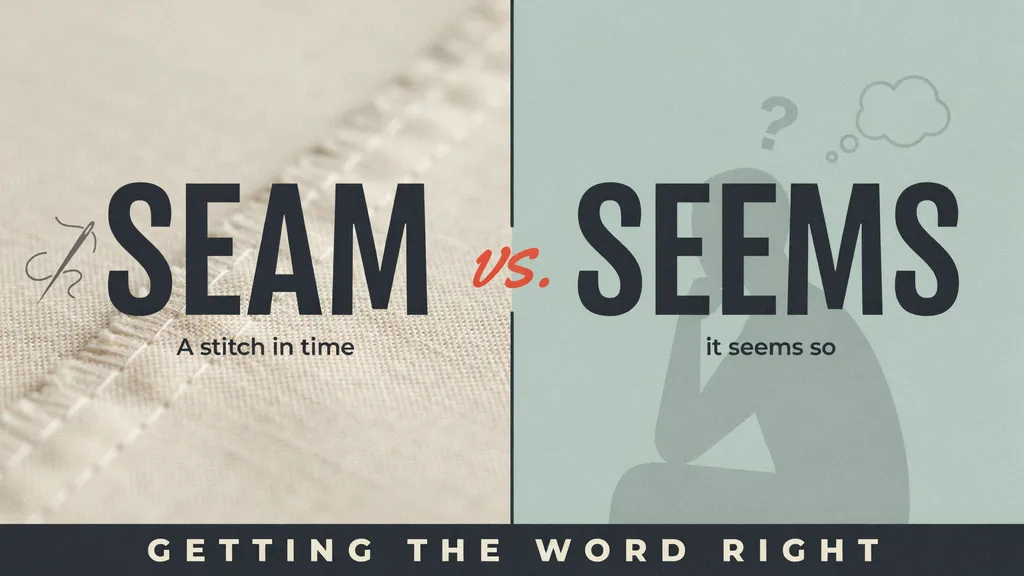
A seam is a noun, it’s basically that physical line where two bits of stuff like fabric, metal, or leather, are put together, joined, kind of stitched at the edge. It’s the seam, not the se em, no. Seem is a verb, and it does the job of giving an impression , or saying it feels like something is true, even if you can’t prove it right away.
So that sentence “The product seams appear to be a bit stronger than the last supplier’s” is off, a little, and yeah it happens. What you probably mean depends on the angle you’re taking. If you mean an impression, like you’re judging from what you’re seeing, then it should be more like “the product’s seams seem a bit stronger”. If you mean the actual joins look more robust, then you can go with “the seams appear stronger”. Either way it’s a small fix, but it’s the sort of thing that slips into spec sheets and marketing copy more often than it ought to, and it drains credibility quickly in B2B writing, where precision matters, and where people are very picky about exact usage .
What “Seam” Actually means, across industries (sorta)
That word does real work, depending on the context, and once you get the different versions it becomes way easier when reading a supplier spec sheet, or even writing your own document, in other words.
In textiles and garment manufacturing:
A plain seam is basically two fabric edges stitched together, the usual construction seam.
Flat-felled seam is folded and double-stitched, it’s built for durability, you see it often in workwear, and also denim.
French seam is fully enclosed, so no raw edge shows , commonly used on delicate or sheer fabrics.
Overlocked (serged) seam is where the edge gets bound up to prevent fraying, very common on knitwear.
Cross seam is a seam that intersects another at a structural junction, like where the sleeve meets the body panel, or close to it anyway.
In metal fabrication:
Seam-welded pipe (ERW) means rolled sheet metal welded along a single seam line.
Seamless pipe is extruded or pierced from a solid billet, so there isn’t any weld seam, at all.
In geology and mining, a seam refers to a layer of a mineral, most often coal, sitting within surrounding rock. It’s the same underlying idea really, a kind of boundary line, where one material meets another, or where it separates.
Seam Line vs. Seam Allowance
Two terms that get conflated all the time, especially in apparel spec documents, yeah:
Seam line is the exact line where stitching occurs, the finished edge.
Seam allowance is the extra fabric between the cut edge and that seam line, usually about 3/8″ to 5/8″ in ready to wear, though it can be as much as 1″ in tailoring so there’s room for later alterations.
So if a tech pack says “sew at 5/8 inch,” that’s typically allowance talk, not the seam line. And if you flip it the wrong way during pattern making, it’s one of the more costly mistakes in a production run, because it shifts the finished garment size, and everything kind of snowballs from there.
Seam vs. Hem Not the Same Function
These get mixed up often because both involve folded, stitched fabric but they do different things, it’s not just semantics
| Seam | Hem | |
| Purpose | Joins two separate pieces | Finishes a single raw edge |
| Typical location | Sides, shoulders, sleeves | Bottom of a garment or sleeve |
| Pieces involved | Two | One, folded on itself |
A single shirt has both side seams joining front and back panels, and a hem finishing the bottom edge. They’re complementary construction elements, not alternatives.
Seam-to-Seam Measurement: Why It Matters for Sizing and Grading
“Seam to seam” is a flat-measurement method used in apparel measuring a garment laid flat, from one seam to its counterpart on the other side, rather than around the body. It’s standard in tech packs and grading rules because it produces consistent, repeatable numbers across sizes and factories.
Seam-to-seam shoulder measurement, specifically, is the distance across the back of a garment from where one shoulder seam meets the sleeve to the same point on the other side. It’s one of the first checks quality control teams run, because a shoulder seam sitting outside the natural shoulder point signals an oversized fit, and one sitting inside it signals the opposite.
For teams managing size charts across multiple factories, standardizing on seam-to-seam measurement (rather than body measurement) removes a lot of the size-drift that shows up when different cutting rooms interpret “chest width” slightly differently.
Seam vs. Seamless, By Product Category
This is where the buying decision actually lives, and it plays out differently depending on what’s being sourced.
Seamless vs. Seam-Welded (ERW) Pipe
Seamless pipe is formed from a solid billet with no weld line, giving it uniform wall thickness and generally higher pressure tolerance. It’s the standard for high-pressure and high-temperature applications oil and gas lines, boiler tubing, and other safety-critical systems, often specified against standards like ASTM A106 or API 5L.
Seam-welded (ERW) pipe is rolled from flat steel and welded along a single seam. It costs less to produce and is entirely adequate for lower-pressure structural, plumbing, and fencing applications.
For procurement: the decision comes down to pressure rating and application risk, not brand preference. Specifying seamless where ERW would meet code is paying for margin you don’t need; specifying ERW in a high-pressure application is a genuine safety liability.
Seamless vs. Sectional (Seam) Gutters
Sectional gutters ship in pre-cut lengths joined with connectors cheaper, easier to install, but every joint is a potential future leak point. Seamless gutters are extruded on-site from a single coil, cut to the exact roofline, with joints only at corners and downspouts.
For contractors or property managers speccing at scale, seamless costs more per foot and requires specialized on-site equipment, but the reduction in leak-related callbacks over the product’s life is usually the deciding factor particularly on longer runs where sectional gutters accumulate more joints.
Seamless vs. Seam Construction in Apparel Leggings, Bras, Underwear
Leggings: seam-constructed leggings are cut and sewn from fabric panels, which allows brands to combine different fabrics or compression levels by zone (knee, waistband, thigh) useful for performance-focused product lines. Seamless leggings are knitted as a single continuous tube, giving a smoother line under fitted clothing and generally more consistent stretch, but with less ability to target compression by zone.
Bras: seam construction allows more structured support (common in underwire and push-up styles), while seamless bras are molded or knit as one piece smoother under fitted tops, but generally offering less structured support, making them better suited to everyday or loungewear lines than high-support categories.
Underwear: the same logic applies seamlessly and eliminates visible panty lines under fitted clothing, while seamed construction is typically cheaper to produce and easier to adjust for fit during pattern development.
None of these are “better” in an absolute sense. They’re different manufacturing methods suited to different product positioning. A brand building a compression-focused athletic line has different needs than one building a smooth-silhouette loungewear line.
Seamless vs. Seam Socks
Toe-seamless construction removes the stitched line across the toe area, which reduces friction and blister risk. This has made seamless toe construction the standard in running socks and a common feature in diabetic sock lines, where friction reduction has a genuine functional (not just comfort) benefit.
Seamless vs. Seam Table Tennis Balls
This one’s purely a manufacturing distinction rather than a style choice. Seamed balls are made from two glued halves, the older standard. Seamless balls are molded as a single piece, removing a seam that could otherwise affect bounce and flight consistency. Since the sport’s move to plastic (poly) balls, seamless construction has become the standard for competitive play because of that consistency advantage.
Seam Tape, Seam Sealer, and Seam Grip Waterproofing Terminology
This cluster causes real confusion because the terms overlap, and picking the wrong product genuinely fails to work rather than just underperforming.
Seam tape is a heat-activated adhesive strip, usually applied at the factory, that seals the needle holes left by stitching.
Seam sealer is a liquid or paint-on compound applied after the fact as the go-to for aftermarket resealing or repair.
Seam Grip is Gear Aid’s (formerly McNett’s) branded line of sealants and adhesives, sold in several distinct sub-types that aren’t interchangeable.
The sub-types matter more than the brand name:
| Product | Base | Best suited for | Key detail |
| Seam Grip WP | Urethane | Polyurethane-coated fabric, canvas, vinyl, leather, rubber | Cures in 8–10 hours, permanent; not for true silnylon |
| Seam Grip SIL | Silicone | Silicone-coated fabric, silnylon/silpoly | Seals up to ~24 feet per tube, self-levels; won’t bond to PU-coated fabric |
| Seam Grip FC | Water-based | Large tents/tarps needing fast coverage | Cures in ~2 hours, covers up to 60 feet, less permanent than WP |
The rule that governs all of this: silicone bonds to silicone, and urethane bonds to polyurethane-coated fabric. Neither crosses over. Before specifying or purchasing a sealant for a production run of outdoor gear, confirm the fabric’s coating type shiny typically indicates polyurethane, matte or slightly tacky typically indicates silicone.
Making the Call: A Practical Framework
Apparel line development: choose seamless for smooth-silhouette or everyday categories; choose seam construction where zone-specific compression, structure, or lower unit cost matters more than a clean line.
Industrial piping specs: default to seam-welded for standard low-pressure runs; require seamless wherever pressure rating, temperature, or safety code demands it.
Gutter installation at scale: seamless reduces long-term leak-related service calls; sectional is faster and cheaper for short runs or budget-constrained jobs.
Outdoor gear production or repair: match the sealant chemistry to the fabric coating first brand and price are secondary to that compatibility check.
FAQs
Is it “seam” or “seem” when describing how something looks?
“Seem” it’s the verb for appearance or impression. “Seam” only refers to a physical joining line.
Does seamless always mean stronger?
No. In pipe, seamless is generally stronger due to uniform wall thickness. In gutters and apparel, “seamless” mainly refers to fewer joints or a smoother surface, not added strength.
What’s the difference between a seam and a dart in garment construction?
A seam joins two separate fabric pieces. A dart is a fold sewn into a single piece of fabric to add shape, typically at the bust or waist.
Can Seam Grip WP be used on silnylon tents?
No. Seam Grip WP is a urethane-based product meant for polyurethane-coated fabric. True silnylon needs a silicone-based sealer like Seam Grip SIL instead.
Why do some manufacturers use seam-welded pipe instead of seamless?
Cost and adequacy. Seam-welded (ERW) pipe is cheaper to produce and performs fine in standard low-pressure structural or plumbing applications where seamless’s higher pressure tolerance isn’t needed.
What does “seam-to-seam” mean on a size chart?
It’s a flat-measurement method measuring a garment laid flat from one seam to its counterpart on the other side used to keep sizing consistent across production runs and factories.
Is seamless underwear better than seamed for a private-label product line?
It depends on the product positioning. Seamless suits smooth-silhouette or everyday lines; seamed construction is usually cheaper and allows more structured fit adjustment, which matters more for support-focused categories.
What’s the actual difference between seam tape and seam sealer?
Seam tape is typically factory-applied during manufacturing as a physical barrier. Seam sealer is applied afterward either during initial finishing on gear that doesn’t ship taped, or as a repair for seams that have worn out over time.
Conclusion
“Seam vs. seamless” isn’t one question, it’s a different trade-off in every category it touches, from pipe pressure ratings to garment silhouette to sealant chemistry. The word “seam” itself is straightforward once separated from its homophone “seem.”
Everything past that point comes down to matching the manufacturing method to the actual functional requirement, not defaulting to whichever term sounds more premium.
Seamless costs more in nearly every category it appears in; the question worth asking before specifying it is whether that cost buys a functional improvement for your specific application, or just a marketing one