
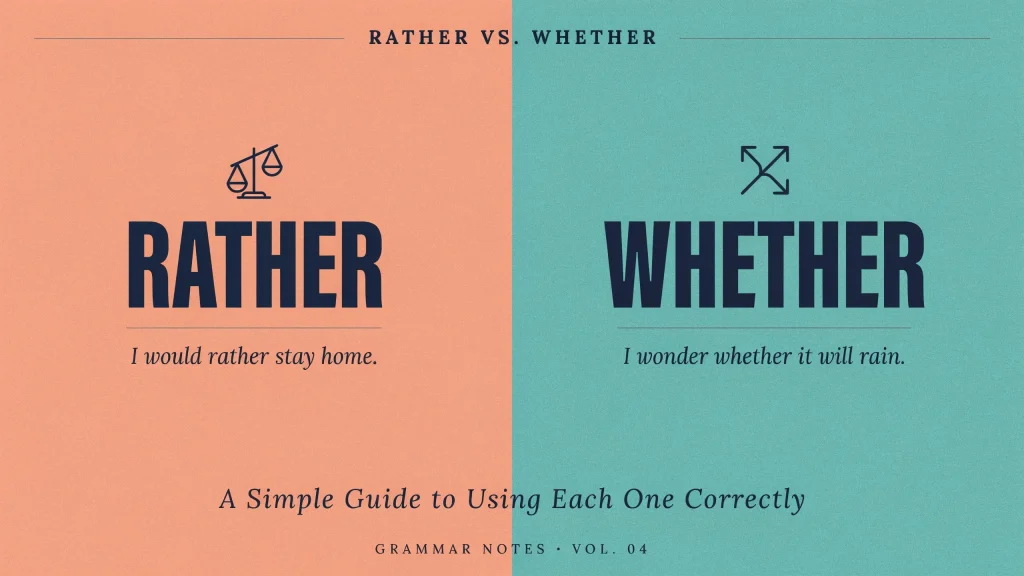
What “Whether” Actually Does
and you know it kind of opens the whole idea, not sure about it sometimes, anyway. “Whether” shows up when you have a choice between two or more options , or when you’re talking about uncertainty about something. It’s like a word that sort of cracks the door for alternative possibilities.
A Couple Pretty Normal Examples, Like:
I still don’t know whether I’m getting the promotion .
She wasn’t sure whether the store would be open on Sunday .
Whether you drive , or take the train you’ll arrive around the same time
See the shape of it: in each case there’s an implied “or” tucked somewhere in the background. “whether I’m taking the promotion” , basically means “whether I’m taking it or not” . That’s the internal logic of the word.
Now, one question people ask a lot is if “whether” and “if” can trade places. In everyday speech, yes, usually. But in more formal, or more carefully written stuff , “whether” is the safer pick , especially when you’re presenting actual alternatives like “whether to stay or go” , or when you’re after a preposition like “the question of whether” .
“Rather” Actually Works Different
, it’s not quite like people expect. It’s an adverb, and it tends to show up in a few, kind of obvious situations, but it gets used in a way that feels off if you treat it like a simple alternative word.
1. When You’re Expressing a Preference
This is probably the most common meaning, it often shows up with “than” too.
I’d rather spend the weekend hiking, than sitting in traffic.
He’d rather work from home on Fridays.
2. When You’re Correcting or Making a Contrast
In these cases “rather” is basically the vibe of “actually” , or “on the contrary” .
She wasn’t upset, rather , she was just tired.
It’s not that he refused; rather, he simply forgot.
3. When You’re Softening or Intensifying a Description
Here “rather” means something like “somewhat” or “quite” but not in a loud way.
The meeting ran rather long.
That was a rather bold move.
And none of those uses are about presenting options the way “whether” does. “Rather” is more about leaning toward something, adjusting what you said, or describing a degree without setting up a real choice.
Side-by-Side: The Fast Way to Tell Them Apart
| Whether | Rather | |
| Type of word | Conjunction | Adverb |
| What it signals | A choice, condition, or uncertainty | A preference, correction, or degree |
| Common pairing | whether…or | rather…than |
| Example | I wonder whether she’ll call. | I’d rather she called tonight. |
A quick mental trick that tends to stick: “whether” pairs with “either” both are about two-sided choices. “rather” pairs with “prefer”** both are about leaning toward one option.
Whether Or Not: When Do You Actually Need the “Or Not”?
This trips people up, more than it should. Technically “whether” already carries the idea of “or not,” so in a sentence like:
I don’t know whether I’ll go.
adding “or not” is optional, not required. It almost never becomes a must, unless you’re trying to really push the point that either outcome is covered, like it does not matter which way things turn out.
It becomes necessary when you’re emphasizing something will happen no matter what:
We’re Having a Picnic Whether or Not It Rains
Here, “or not” is doing real work. It’s basically saying the plan goes forward either way, rains or not. If you drop it, the sentence still works, just the “no matter what” feeling is a little less sharp.
Also, one small thing to clear up right away: “rather or not” isn’t a standard English phrase. If you’ve seen it, it’s very likely just a typo for “whether or not.” There’s no dictionary entry, no true grammar rule, and no widely accepted use for “rather or not.” So if you’re ever unsure which version to type, go with “whether or not” it’s the safe, correct choice.
The Small Mistake That Started All This Weird Confusion
Most folks who type “rather or whether” into a search bar aren’t truly torn between the two words in their heads; they’re just trying to recall which one belongs in the sentence they already started. It’s less like “these two words are similar” and more like “I kind of forgot what each one is supposed to do.”.
So yeah, the quickest fix isn’t memorizing definitions, it’s doing a little substitution test, kind of fast:
Can you swap the word using “eitheror” logic? Try it with the weather.
Can you swap the word using “prefer”? Try it rather.
Then check it on a real sentence:
“I’m not sure I should call her tonight or wait until morning.”
If you plug in “either” it works great, so the answer is whether.
“Honestly, I’d wait until morning.”
If you plug in “prefer” it also works, so the answer is rather.
This trick usually lands, because it hits what the word actually does, not some abstract rule you have to drag out while you’re under pressure.
The Small Mistake That Started All This Weird Confusion
Most folks who type “rather or whether” into a search bar aren’t truly torn between the two words in their heads; they’re just trying to recall which one belongs in the sentence they already started. It’s less like “these two words are similar” and more like “I kind of forgot what each one is supposed to do.”.
So yeah, the quickest fix isn’t memorizing definitions, it’s doing a little substitution test, kind of fast:
Can you swap the word using “eitheror” logic? Try it with the weather.
Can you swap the word using “prefer”? Try it with rather.
Then check it on a real sentence:
“I’m not sure I should call her tonight or wait until morning.”
If you plug in “either” it works great, so the answer is whether.
“Honestly, I’d wait until morning.”
If you plug in “prefer” it also works, so the answer is rather.
This trick usually lands, because it hits what the word actually does, not some abstract rule you have to drag out while you’re under pressure.
Don’t Forget the Third Word: “Weather”
Any talk about “whether” ain’t really done until you slide in its sound like buddy, “weather.” In a lot of English accents they sound almost the same, so in writing people mix them up, yeah it happens .
Weather is about the sky state, like rainfall, bright sun, the temperature, or sudden tempests.
Whether it is about a choice, or a sort of condition, like if something is one way or the other , depending on how you look at it.
Here’s a sentence where all three show up the right way,
“Whether the weather holds up or not, I’d rather stay indoors and read.”
If you can keep that line straight, you’ve kinda mastered all three words at once, or at least you’re pretty close.
A Simple Self Check Before You Publish or Send
Before you finalize a message essay, or article, do a quick run, through this short list
Am I showing a choice, or maybe sounding unsure? Use the weather.
Am I saying you prefer something? Use rather (usually with than).
Am I fixing up, or setting up a contrast with what I said earlier? Use rather
Am I talking about weather, temperature, or climate? Again use the weather
Does my sentence use “or not” for extra emphasis on what will happen?
Whether or not is correct, rather or not is not really a phrase
This kind of fast mental pass takes seconds, but it catches most of the mix ups before they ever reach an actual reader.
Real Life Examples That Kind of Mash Both Words Together
Sometimes the two terms really do land in the same sentence, and honestly that can help you see the difference a bit more clearly.
“Whether we leave now, or later, I’d rather not sit in rush-hour traffic”
“I don’t know whether she’s coming, but I’d rather we waited to eat.”
“Rather than debate whether it’s worth the cost, let’s just try it.”
Here, “whether” is taking care of the part where a choice or condition is introduced. Meanwhile “rather” is handling the separate job of showing preference. They aren’t exactly battling each other for the same spot in the sentence, they just appear close by because both thoughts belong there.
Frequently Asked Questions
Is “Whether” Kind of the Same as “If”?
Yeah, sort of, but not in a clean way. In everyday chat people blur ’em a bit , still “whether” feels sharper, more formal, especially when you set up two choices, or after a preposition like, the question of whether.
Can a Sentence Actually Start With “Rather”?
Sure, it happens pretty often when you’re correcting yourself or pushing back. Like , Rather , I meant the other option. Or rather than wait, we left early.
And “I Would Rather Go” … Is That Right Though?
Pretty much, yes. The form is “I would rather go” with no extra “to” sitting there. Not “I would rather go” , that one’s wrong.
So What’s the Difference Between “Would Rather” and “Had Rather”?
They overlap in meaning, but “had rather” is older, you’ll almost never see it in modern English. These days, it’s basically “would rather” every time.
Is “Rather or Whether” Ever Correct as a Phrase on Its Own?
Not really, no. It usually shows up when someone is unsure which word belongs in the sentence, more like a mental stutter than actual grammar.
Why Do “Weather”, “Whether” and “Rather” Keep Getting Mixed Up?
“Weather” and “whether” are close enough that people swap them when typing. And “rather” gets dragged into it too, because it sounds similar and it shows up in decision type sentences.
Does “Whether” Always Have to Be Followed by “Or Not”?
Nope. “Or not” is optional in most cases since the meaning already lands. People add it for emphasis, like regardless of the outcome, etc.
What About “Whether Than”? Is That Ever Okay?
No. If you’re comparing, you want “rather than” and not the other one.
Conclusion
At the end of the day the difference between “rather” and “whether” is what each word is doing. “Whether” opens up a choice or signals doubt. “Rather” leans toward preference, corrections, or a softer tone. They’re not really interchangeable, so you don’t fix it by memorizing random tiny rules, you fix it by noticing the job your sentence needs.
Quick substitution test: try “either/or” and see if “whether” makes sense, swap in “prefer” for “rather” and the right one usually jumps out. After a bit of repetition, it stops feeling like a puzzle.