
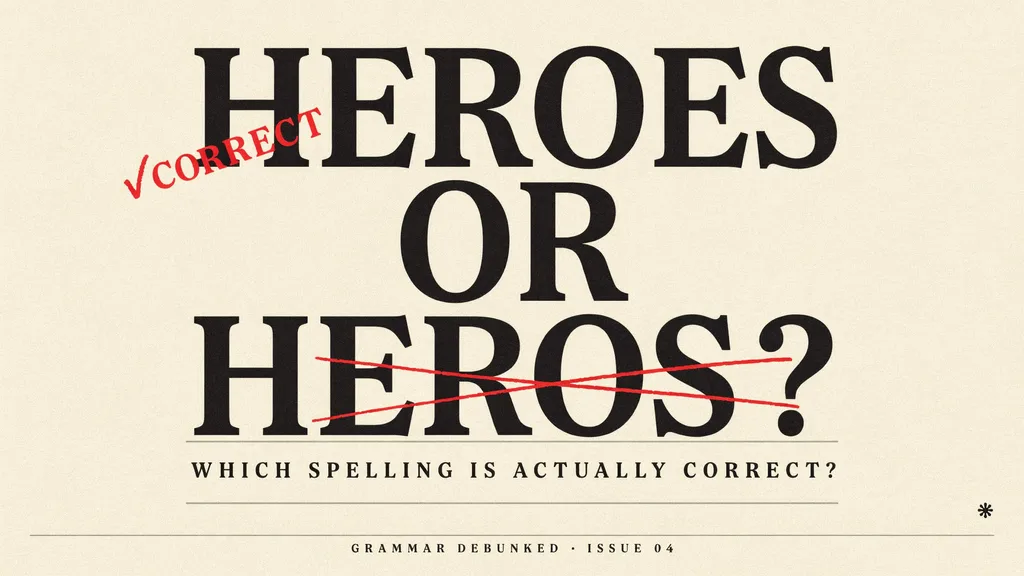
If you’ve ever typed “heros” and then paused, wondering if it looked wrong, you’re not alone. It’s one of those words that trips up even confident writers, because English pluralization doesn’t always play by consistent rules.
Here’s the short version: “heroes” is the correct plural of “hero.” “Heros” is a misspelling in almost every everyday context. But there are a few real exceptions worth knowing, and understanding why the rule exists will stop you from second-guessing yourself every time you type it.
Bn Let’s go through the whole picture: the rule, the reasoning, the exceptions, and the sentences that trip people up most.
The Quick Answer
When you’re talking about more than one hero firefighters, athletes, fictional characters, people you admire, the correct spelling is always heroes.
Correct: “The rescue workers were heroes.”
Incorrect: “The rescue workers were heros.”
That’s the rule in one sentence. Everything else in this article explains the reasoning, the exceptions, and how to apply it confidently in your own writing.
Why Does “Heros” Feel Right to So Many People?
This isn’t a random typo pattern. There are a few real reasons the mistake shows up so often, even among people who otherwise write well.
English is inconsistent with words ending in -o.
Some words just add an -s (photo becomes photos, piano becomes pianos), while others add -es (potato becomes potatoes, echo becomes echoes). Your brain has seen both patterns thousands of times, so when it hits “hero,” it’s genuinely a coin flip unless you’ve memorized which side the word falls on.
Greek origins add to the confusion.
The word “hero” comes from the ancient Greek hērōs, and in classical studies or mythology writing, you’ll occasionally see “heros” used as a transliteration of that Greek term. Seeing it in that context even once can plant the idea that it’s an acceptable English spelling, when it’s really a different word being discussed in a different language context.
Autocorrect doesn’t always catch it.
Because “Heros” exists as a legitimate name, brand, and title in other contexts (more on that shortly), some spellcheckers won’t flag it as an error, which gives people false confidence that they typed it correctly.
None of these reasons make “heros” correct as a common noun. But knowing where the confusion comes from makes the rule easier to remember for good.
The Actual Grammar Rule
English nouns that end in a consonant plus the letter o typically form their plural by adding es, not just -s. This is the same pattern you’ll see across a small, recognizable group of words:
| Singular | Plural |
| Hero | Heroes |
| Potato | Potatoes |
| Tomato | Tomatoes |
| Echo | Echoes |
| Volcano | Volcanoes |
Notice the pattern: consonant, then “o,” then the plural adds “-es.” That’s exactly what happens with “hero.”
Now compare that to the words that break the pattern:
| Singular | Plural |
| Photo | Photos |
| Piano | Pianos |
| Logo | Logos |
| Video | Videos |
| Solo | Solos |
These exceptions tend to be either shortened forms of longer words (photo from photograph), musical terms borrowed from Italian (piano, solo), or modern coinages (logo, video). “Hero” isn’t part of that group; it’s an older, fully naturalized English word, and it follows the standard -es pattern without exception.
The practical takeaway
: if you’re ever unsure whether an -o word takes -s or -es, and the word isn’t one of the recognized exceptions (photo, piano, logo, video, solo, kilo, and a handful of others), default to -es. It’s right far more often than not, and it’s always right for “hero.”
Is There a Difference Between American and British Spelling?
No and this is worth stating clearly because plenty of English spelling differences do exist between American and British English (color vs. colour, organize vs. organise, and so on).
“Heroes” is not one of them. Both American English and British English use the exact same spelling for the plural of hero. If you’ve searched for a UK-specific version of this word, you can stop looking there isn’t one.
What does create some UK-flavored search confusion is that a few well-known things happen to share the word “heroes” as a name, which brings us to the exceptions that actually matter.
When “Heros” Is Actually Correct
Here’s where things get genuinely interesting, because “Heros” isn’t always wrong it’s wrong specifically when you’re using it as the plural of the common noun “hero.” As a proper noun, it can be perfectly legitimate.
Heroes, the TV Series
Heroes is an American science-fiction drama that first aired in 2006, following an ensemble cast of ordinary people who discover they have extraordinary abilities. The show became a cult favorite and is still frequently searched for its cast, its plot twists, and its eventual cancellation and reboot attempts.
When you’re referring to the show, it’s a title capitalized and typically italicized in formal writing but it’s still spelled with the “e.” There’s no version of the title spelled “Heros.”
Cadbury Heroes
In the UK, “Heroes” is also the name of a well-known Cadbury confectionery product: a tub or tin filled with an assortment of miniature chocolate bars, popular around the holidays alongside similar tubs like Celebrations and Roses. Again, the brand name uses the standard spelling “Heroes,” not “Heros.”
The Hero Sandwich
In parts of the United States, especially the Northeast, a large sandwich made on a long roll and packed with meats, cheese, and toppings is called a “hero.” Depending on where you are, the same sandwich might be called a hoagie, a sub, or a grinder regional naming is part of the fun of American food culture.
The plural here follows the same rule as everywhere else: more than one of these sandwiches are “heroes,” not “heros.”
Names and Trademarks
Occasionally, “Heros” shows up as a personal name, a company name, or a stylized product name. Businesses can spell their names however they like, trademark spelling doesn’t follow grammar rules but that doesn’t change how the common noun is spelled in your own writing.
The key distinction to remember
: if you’re describing real people, fictional characters, or anything using “hero” as an ordinary word, the plural is always “heroes.” If you’re referencing a specific title, brand, or name, follow that entity’s official spelling but recognize that it’s a separate case, not a grammar exception you can generalize from.
Heroes vs. Heroes at a Glance
| Question | Heroes | Heros |
| Is it in the dictionary as the plural of hero? | Yes | No |
| Correct in an essay, email, or article? | Yes | No |
| Correct as a brand name (Cadbury) or show title? | N/A | Yes |
| Correct in casual texting or social posts? | Yes | Common mistake, still incorrect |
| Differs between US and UK usage? | No | No |
Putting It Into Practice: Example Sentences
Seeing the word in context is often the fastest way to make a spelling rule stick. Here are some real-world examples covering different tones and situations.
“The nurses who worked through the pandemic were true heroes.”
“My grandparents are my heroes, they built a life from nothing.”
“The movie follows a group of unlikely heroes trying to save their town.”
“Superheroes and everyday heroes both deserve a place in the story.”
“Heroes remains one of the most talked-about shows of the 2000s.” (title, proper noun)
“She brought a tin of Cadbury Heroes to the office party.” (brand name)
“We ordered two heroes from the deli down the street.” (regional sandwich term)
Notice that in every case where the word functions as an ordinary descriptive noun describing people, qualities, or characters it’s spelled “heroes.” The only times you’ll see “Heros” are when it’s functioning as a specific, capitalized name.
The Wider Word Family
Understanding related words helps the spelling rule stick even better, since they all follow logical, connected patterns.
| Word | Type | Meaning |
| Hero | Noun (singular) | A person admired for courage or noble qualities |
| Heroes | Noun (plural) | More than one hero |
| Heroine | Noun (singular) | Traditionally, a female hero; modern usage increasingly favors “hero” for any gender |
| Heroic | Adjective | Describing courageous or admirable behavior |
| Heroism | Noun | The quality or act of being heroic |
| Heroically | Adverb | Done in a heroic way |
None of these related forms use “heros” at any point. If you’re confident about the rest of the word family, “heroes” should start to feel just as automatic.
What About “Superheroes”?
This one trips people up almost as often as the original word, and the answer is exactly what you’d expect: since “superhero” is just “hero” with a prefix attached, it follows the identical rule.
Correct: superheroes
Incorrect: superheros
If you remember the base rule for “hero,” you already know the rule for “superhero” too, no separate memorization required.
Common Mistakes and How to Catch Them
A few situations tend to produce this error more than others, and knowing them in advance makes them easier to catch before you hit publish or send.
Formal writing under time pressure.
Essays, cover letters, and work emails are where this mistake matters most, and where a quick final read-through pays off.
Fast, casual typing
. Texting and social media posts are the most common place “heros” slip through, mostly because there’s less incentive to double-check.
Overgeneralizing from other -o words
. If you’ve recently typed “photos” or “videos,” your brain may carry that pattern straight into “heros” without you noticing.
Trusting autocorrect completely
. As mentioned earlier, some spellcheckers won’t flag “Heros” because it’s a valid brand or name elsewhere which means the responsibility falls back on you.
A Simple Way to Check Yourself Every Time
If you want a foolproof method rather than just memorizing the rule, use this quick mental checklist:
- Are you talking about people, qualities, or characters?
If yes, you need the common noun always “heroes.” - Are you referencing a specific title, brand, or name?
If yes, use that entity’s official spelling, whatever it happens to be. - When in doubt, default to “-es
.” It’s correct for the vast majority of consonant-plus-o words, hero included. - Do a final read-through
if the writing is going somewhere formal a resume, an article, a school assignment, or a professional message.
That’s really all it takes. Once the rule clicks, you won’t need to think about it again.
Frequently Asked Questions
Is it “heros” or “heroes”?
“Heroes” is the correct spelling when referring to more than one hero. “Heros” is a common misspelling, except when it’s used as a proper name, brand, or title.
What is the plural of hero?
The plural of hero is heroes, following the same pattern as potato potatoes and tomato tomatoes.
Why do some words ending in -o just add -s instead of -es?
It largely comes down to a word’s origin. Musical terms and modern loanwords like piano, photo, and logo tend to add a simple -s, while older, fully naturalized English words like hero, potato, and tomato add -es.
Is “heros” ever the correct spelling?
Yes, but only as a proper noun for example, in the title of the TV series Heroes (spelled with the standard “e,” so this is really a myth to clear up), a stylized brand name, or a personal name. As the plural of the common noun “hero,” it’s always incorrect.
Do British and American English spell “heroes” differently?
No. Unlike many other US/UK spelling differences, “heroes” is spelled identically in both varieties of English.
Is it “superheros” or “superheroes”?
“Superheroes” is correct, since “superhero” follows the exact same pluralization rule as “hero.”
What’s the difference between the word “heroes” and the Cadbury or TV show “Heroes”?
They’re the same spelling used in different contexts. “Heroes” as a common noun means more than one hero. “Heroes” is also the name of a UK chocolate tub brand by Cadbury and the title of a 2006 American TV series both are proper nouns, so they’re capitalized, but they still use the standard spelling.
Is “heroine” spelled differently from “heroes”?
Yes, “heroine” refers to a singular female hero, while “heroes” is the plural form used for any group of heroes. They come from the same root word but serve different grammatical purposes.
Conclusion
The rule really does come down to one sentence: the plural of “hero” is “heroes,” and “heros” only belongs in writing when it’s the name of something specific, a show, a brand, or a person not when it’s describing people who show courage or admiration-worthy qualities.
Once you tie that rule to the small family of words that behave the same way as potatoes, tomatoes, echoes, volcanoes it stops being something you have to look up and becomes something you simply know. The next time you’re writing about the people who inspire you, you can type “heroes” with full confidence.