
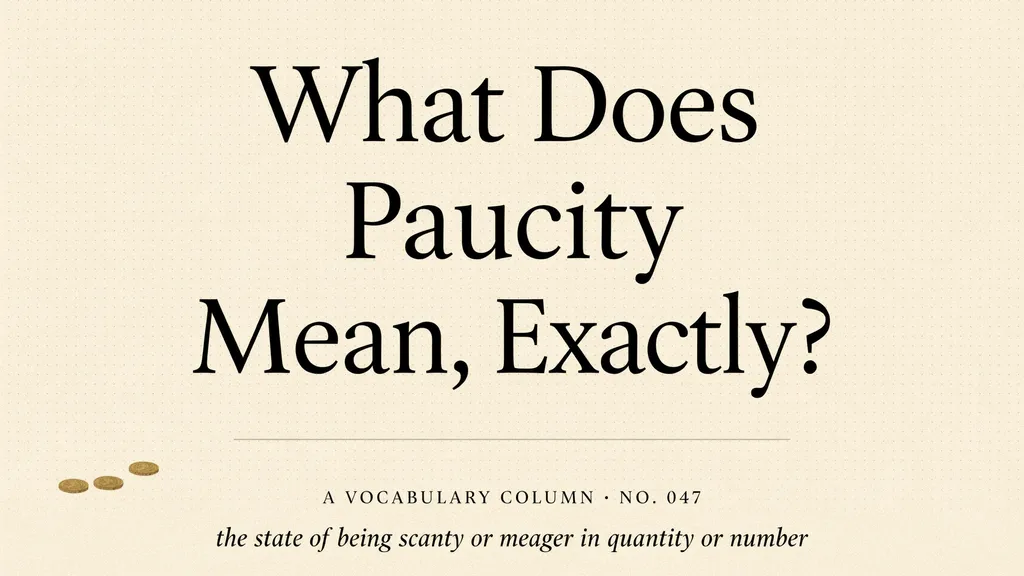
Paucity is a noun. It means a smallness of number or quantity ,and also a kind of inadequate supply of whatever comes next. Kind of like, there isn’t enough of it, you know.
It almost never stands alone. You’ll see it in the pattern “a paucity of”, where the space is the thing that’s actually running short , a paucity of evidence , a paucity of rainfall , a paucity of good ideas.
MerriamWebster defines it in a pretty straightforward way: smallness of number or quantity, fewness on one side, dearth on the other. That’s pretty much the whole idea in two words ,few and not enough.
What makes paucity useful, as opposed to just being a fancier way to say “not much,” is the tone. It’s a formal word . You’ll spot it in academic writing, journalism, law, and medicine far more often than in a text message to a friend.
Paucity how to say it
People get stuck here, because it kind of looks different from how it sounds, so yeah.
Easy way to pronounce it: PAW-suh-tee, that’s it.
US IPA: /ˈpɒː.sə.ti/
UK IPA: /ˈpɔː.sɪ.ti/
Stress: put it on the first syllable, not later
The “au” part is like “aw” in “law” or “saw”, not the “ow” sound in “cow”. Once that first bit is right, everything else comes together pretty naturally, it really does.
Where the word comes from
Paucity has been part of English since the late 1300s, and yeah it did not just appear out of nowhere. It traveled here from Old French paucité, and that, in turn, comes from the Latin paucitas “fewness”, which is rooted in paucus meaning “little” or “few”.
That Latin bit is kind of a small family reunion, I guess, but in disguise too, because words like “few” and, a bit more indirectly “pauper”, trace back to related roots as well. Honestly, a lot of dictionary editors use the paucity–pauper link as a memory trick: a pauper has too little money, and paucity is when something is too little, overall.
Is Paucity positive or negative?
It’s negative, in tone if not always in outcome. Paucity always points at a shortfall , even when it’s used in a neutral, clinical, or statistical way rather than an emotional one.
That’s honestly one of the more common mix-ups with this word. Because “paucity” kind of sounds like “capacity” or other words linked with largeness, some readers assume it means “a lot.” But no, it’s the opposite. If you remember only one thing from this piece , make it this: paucity always means too little, never too much.
Grammar Notes You’ll Actually Use
A few quick rules keep your usage clean, mostly.
It’s a noun almost always singular. “Paucities” technically exists, but it’s rare enough that using it will draw attention, for sure.
It needs “of.” “There is a paucity” on its own feels incomplete. “There is a paucity of funding” is the natural, complete version, not just “there is”.
There’s no common adjective form. Writers often reach for “scarce” “scant” “sparse” or “insufficient” instead, even if the meaning is close.
It’s a formal register. In a report or thesis it fits naturally. In casual conversation it can sound stiff, and “not enough” usually works better there.
Paucity vs. Its Closest Synonyms
Paucity has plenty of company in the “not enough” family, but each one leans a bit different way. It’s also where many writers sort of reach for the wrong synonym, and then the meaning gets messy or too wide, ya know.
| Word | What it emphasizes |
| Scarcity | A general shortage of something widely needed water, resources, jobs |
| Dearth | A near-total or keenly felt lack; slightly more literary than paucity |
| Shortage | A gap against an expected level, often temporary |
| Insufficiency | Not meeting a required standard for a specific purpose |
| Sparsity | Thin or uneven distribution, not just a small total |
| Deficiency | A missing necessary component, often used clinically |
| Lack | The plain, everyday version with no formal weight at all |
Antonyms worth knowing, also you know: abundance, plenty, profusion, surplus.
So if you are choosing between “paucity” and “scarcity” for a sentence about clean water access , “scarcity” is probably the better fit, it is the standard term in that field. Keep “paucity” for situations where a more formal precise word is actually useful .
Common Phrases: “Paucity of” decoded
Most people who are searching around for this word are usually trying to grasp one particular phrase , so yeah. Here is a quick little reference , just to make it clearer:
| Phrase | What it means |
| Paucity of time | Not enough time to do something properly |
| Paucity of funds | Insufficient money for a cost or project |
| Paucity of data | Too little recorded information to draw a solid conclusion |
| Paucity of evidence | Evidence exists but falls short of what’s needed to prove a point |
| Word paucity | A limited vocabulary or noticeably narrow word choice |
| Paucity of speech | Reduced spontaneous speech output |
| Paucity of movement | Noticeably reduced physical movement |
Notice the pattern , paucity basically always points to “less than needed” not “completely absent”. A paucity of data isn’t exactly the same as no data at all, and that nuance is often why a writer picks this term over a blunter option, or so it seems.
Paucity in Medicine: what it really means on a report
If you’ve ever seen “paucity” on a medical report , here’s the sort of context that tends to get left out.
Paucity of bile ducts.
This usually means there are fewer small bile ducts inside the liver than expected. Most of the time it’s noticed through a liver biopsy, and it’s considered one recognized reason for long-lasting jaundice in newborns and infants.
Now, when this finding shows up together with certain heart, eye, bone and facial characteristics, clinicians describe it as the syndromic form, tied to a genetic condition called Alagille syndrome. There is also a non syndromic form, where those extra features aren’t present.
.
Paucity of bowel gas.
On an abdominal X-ray, radiologists expect to see some gas outlining the bowel. When there’s less than expected sometimes described as a “gasless abdomen” in more severe cases it’s a descriptive observation, not a diagnosis by itself. It might be normal, post-surgical, or a clue pointing toward something else, like fluid or an obstruction, and it’s always read in context with the rest of the imaging.
Paucity of intra-abdominal fat
. This one shows up mostly in pediatric imaging notes, usually as an incidental observation tied to body size rather than a red flag on its own.
A quick but important caveat: none of this is medical advice. If a report you’ve received uses one of these phrases, the right move is always to ask the ordering clinician what it means in your specific case. The same wording can point toward very different next steps depending on everything else in the picture.
Paucity in Law: “A Paucity of Evidence”
In legal writing, “a paucity of evidence” is a precise, deliberate phrase. It says the available evidence is thin not that it’s missing entirely.
That’s a meaningful difference in a courtroom. “No evidence” and “not quite enough evidence” lead to very different arguments, and paucity is the word attorneys and judges reach for when they mean the second one.
You’ll also see “paucity of precedent” or “paucity of case law,” which means very few prior rulings address a specific legal question making that issue harder to resolve using precedent alone.
Paucity in Everyday Writing: Example Sentences
Seeing the word in context is often the fastest way to internalize it:
The committee cited a paucity of affordable housing as the city’s biggest challenge.
Researchers were cautious in their conclusions, given the paucity of long-term data.
A paucity of rainfall this season has left reservoirs well below normal.
The court noted a paucity of evidence linking the two events.
Given the paucity of time before the deadline, the team scaled the project back.
Her recommendation letter praised his work ethic despite a paucity of prior experience.
Investors grew uneasy over the paucity of detail in the earnings call.
Common Mistakes People Make With This Word
A few habits are worth breaking early:
- Assuming it means “a lot.”
It’s unfamiliar enough that people sometimes guess backward. It never means abundance.
- Dropping the “of.”
“There’s a paucity” reads as unfinished to most readers.
- Using it in casual speech.
It’s a formal word save it for writing where that tone fits.
- Confusing it with “poverty.
“ They share a distant root, but paucity describes an amount; poverty describes a broader state of lacking resources.
- Pluralizing it out of habit.
“Paucities” is valid but almost never necessary.
A Word That’s Done This Job for 600 Years
What’s genuinely interesting about paucity is how little its meaning has shifted. From 14th-century Old French through modern medical charts and courtroom transcripts, it has always meant the same thing: not enough of something specific.
That consistency is part of why it still shows up in formal writing today it’s precise, it’s unambiguous once you know it, and it draws a clean line between “none” and “not quite enough,” a distinction plain English doesn’t always make easily.
Frequently Asked Questions
What is the simplest way to define paucity?
Not enough of something, an insufficient quantity or number.
Is paucity a formal or casual word?
Formal. It fits naturally in reports, academic writing, and journalism, but can sound stiff in everyday conversation.
What is the opposite of paucity?
Abundance, plenty, or profusion.
Can paucity describe people, not just things?
Yes. “A paucity of qualified candidates” or “a paucity of volunteers” are both natural uses.
Is it “paucity of” or “paucity in”?
“Paucity of” is the standard, widely accepted pattern. “Paucity in” appears occasionally but reads less naturally.
What does “paucity of evidence” mean in a legal context?
It means the evidence presented exists but isn’t strong or complete enough to fully support a claim or ruling different from there being no evidence at all.
What does “paucity of bile ducts” mean on a medical report?
It means a liver biopsy showed fewer bile ducts than expected, a finding associated with certain causes of infant jaundice, including Alagille syndrome. It’s a finding for a doctor to interpret, not a diagnosis in itself.
Does paucity have a plural form?
Technically, “paucities” but it’s rarely used, since the word almost always appears in the singular.
Conclusion
Paucity is one of those words that looks intimidating until you actually need it and then it turns out to be exactly the right tool for the job. It says “not enough” with more precision than plainer alternatives, and it draws a useful line between something being scarce and something being completely absent.
Whether you’re reading a court opinion, a liver biopsy result, or just trying to sharpen your own writing, the same idea holds every time: paucity means less of something than you need, not none of it.