
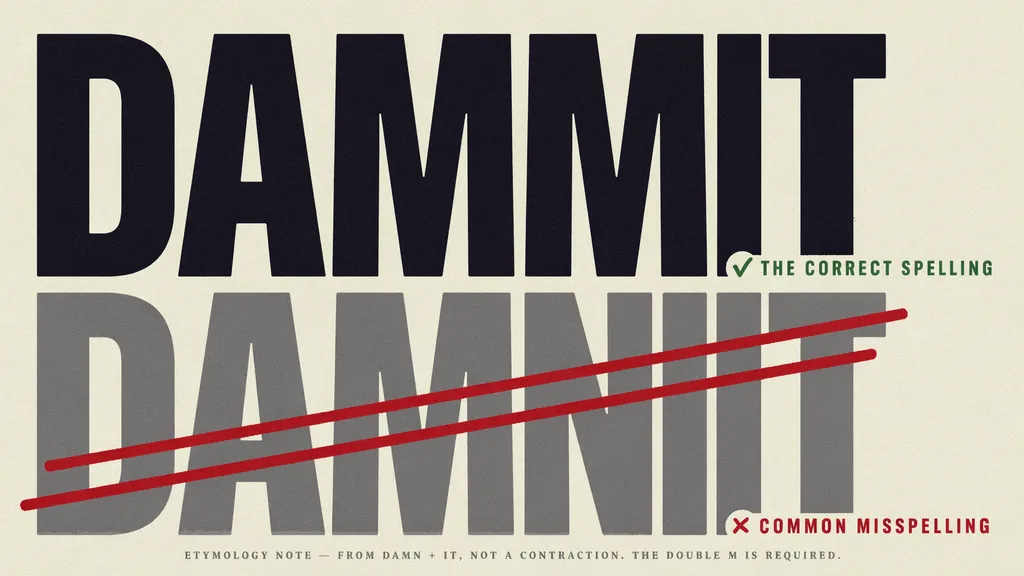
If you’ve ever typed this word mid-sentence and then you paused, like wait… did I spell that wrong , you’re not the only one. It’s one of those words that feels a bit wrong no matter how you write it, mostly because English lets you toss it out two different ways and only one gets treated as the real standard.
Here’s the short bit: dammit is correct. Every big dictionary Merriam Webster, Oxford, Cambridge, Collins, Dictionary.com, all of them list “dammit” as the standard informal spelling. Damnit , on the other hand, isn’t recognized anywhere as a proper headword. If you try searching “damnit” on most dictionary sites, you’ll usually get redirected straight to “dammit” instead.
So yeah, that’s the quick answer. The rest is about why it’s true, when it actually matters, and how you should handle it if you’re writing for readers who care about tiny details that, if you do content, marketing, or editorial, you probably do too.
Dammit vs. Damnit vs. Damn. What’s the real difference?
Okay so, all three forms mean the same thing , like, they’re mild expletives as interjections used to show frustration or annoyance , or sometimes just surprise . Kinda like “darn it,” but with a little more bite to it. The difference isn’t the meaning at all. It’s mostly spelling conventions , and also how formal it looks in writing.
| Form | Correct? | Word Count | Best Used For |
| Dammit | Yes dictionary-standard | One word | Casual writing, dialogue, social copy, texting |
| Damnit | No common misspelling | One word | Not recommended in any context |
| Damn it | Yes the full, uncontracted phrase | Two words | Slightly more formal or deliberate emphasis |
Here’s the thing worth remembering: “damn it” is the source phrase, “dammit” is the accepted contraction , and “damnit” is what happens when someone tries to squeeze the whole idea into one word but accidentally keeps a letter that doesn’t belong there anymore. Kinda like it just refuses to behave and then it shows up anyway.
Why “Dammit” works, and why “Dammit” doesn’t
This isn’t some random style thing , there’s a real language reason tucked in it and yeah it mostly comes down to how people say it.
The word “damn” carries a silent N. Nobody really drops the N sound when they say “damn”, it rhymes with “dam”, the kind that holds back a river. So when “damn” runs into “it” in speech it comes out like “dam-it”, not “damn-it”.
English has this old, reliable habit for contractions like that : you double the consonant before adding the next bit, just to keep the vowel short and steady. Like “sit” turning into “sitting”, or “run” turning into “running”. If you use that same rule of thumb here, then “damn it” should naturally become “dammit” with the doubled M, and no N.
“Damnit” breaks the pattern. It puts the silent letter back again, even though there’s no real sound reason for it , which is exactly why dictionaries mark it as a spelling mistake, not a grown-up variant. It’s a pretty normal slip, it even looks like it follows from “damn” in a neat little way. But it just doesn’t line up with how anyone actually pronounces the word.
What the Dictionaries actually say
It helps to have this laid out plainly, because “trust me” isn’t exactly a solid source when you’re trying to close a spelling question for good , or at least for a while.
Dictionary.com has “dammit” as a standard American entry, and they describe it as an informal, kind of phonetic spelling of “damn it” . There’s also a separate British listing, defining it as a contracted version of the same thing. They trace its first recorded use to somewhere between 1905 and 1910 , give or take.
Oxford plus Merriam-Webster keep the same idea: “dammit” is treated as the recognized headword , and it’s labeled as an informal interjection.
Cambridge and Collins do the same general approach, accepted even if it feels a bit casual , in the way they categorize it.
None of the big dictionaries list “damnit” as its own standalone entry. When it appears at all, it’s usually flagged as a variant spelling that should be redirected, not treated like a legitimate alternative.
Is “Dammit” a bad word?
Technically yes, it’s tagged as a mild expletive. Practically, it sits near the lower end of the profanity scale , which is exactly why it shows up in places where harder words just won’t.
A couple of useful things to know about where it lands on the acceptability spectrum:
Broadcast and streaming media often let “dammit” through unbleeped in situations where tougher swear words get bleeped or cut. It’s generally mild enough to get past most content checks.
In everyday conversation it’s basically shrugged off; most people won’t really react if a coworker says it after spilling coffee on their desk .
Academic and formal writing usually avoids it, the same way they avoid contractions and casual interjections in general, you know that whole style rule thing.
Professional and B2B content is where it gets more complicated, and it’s situational , more on that below, because this is the part a lot of grammar guides skip over , almost entirely.
US vs. UK: Does the spelling Change?
No, and this is one of those rare spelling questions where American and British English agree fully, like completely..
| Aspect | United States | United Kingdom |
| Standard spelling | Dammit | Dammit |
| Formality level | Mild expletive | Mild expletive |
| Broadcast treatment | Frequently allowed pre-watershed and in daytime content | Frequently allowed pre-watershed |
| Alternative mild expletives | “Dang it,” “darn it” | “Blimey,” “blast it,” “bloody hell” (stronger) |
If you’re writing for a US audience, a UK audience, or both, “dammit” is pretty safe to use, consistently without fussing about spelling by region. The cultural tolerance for it is also pretty much similar on both sides of the Atlantic, even if British English tends to have that wider bench of alternative mild expletives to reach for when you want to vary the tone a bit.
Handling “God Dammit” and Some Nearby Variants
This is also where people seem to get derailed a second time , right after they think they’ve handled the first spelling issue.
God dammit, two words
that’s the usual thing you’ll see in print and in casual dialogue.
Goddammit, one word
a tighter contraction, and it shows up a lot in fiction and in more informal types of writing.
Goddamnit is a bit off
because it ends up keeping the silent N that “dammit” already drops. It’s not super standard, sure , but you may still run into it now and then.
Best rule of thumb: if you’re going with two words, “god dammit” works. If you prefer the single-word version, use “goddammit” , and it matches the same sound logic as “dammit” on its own, rather than bringing back a letter that you don’t actually say.
When to actually use “dammit” in writing
This is a bit of a lot of grammar explainers kind of glossed over, but it’s the one that actually matters when you’re making content for a business , a brand, or even a client. Not just feeding that personal curiosity.
Good places for “dammit”
– Fiction, screenwriting, and dialogue, where you want the character to feel natural and… kinda
real
Casual blog posts, personal essays, or social captions with that laid-back, talking-to-a-person energy
Marketing copy where the brand is leaning informal, a little irreverent, or more joke-forward
Internal team notes, Slack messages, or anything else that’s genuinely casual
When you should avoid it (or swap it out for “damn it” , or just ditch the whole expletive)
Client-facing business emails, proposals , and anything meant to feel polished, clean through
Corporate blog content where the voice is formal conservative, or very “buttoned up”
Academic papers technical documentation, or anything compliance-related
Any copy that goes out under a brand that hasn’t specifically said “yeah this level of edgy is fine”
So if you’re running content for a company and you’re not really sure where the brand voice guide lands on mild profanity, the safer route is to default to more neutral phrasing. Or, just flag it for a quick style check before it ships. One “dammit” in the wrong client communication is, sure, a small thing. But small things are also often what erode credibility the fastest in professional writing.
Common Mistakes to Avoid
Damnit, the most frequent error: adding a letter that isn’t pronounced
Dammit, an overcorrection where you slap on an extra N somewhere it does not belong, kinda out of nowhere
Dam it, dropping a letter entirely, then somehow referencing an unrelated word, like a literal dam, the kind that holds back water… which is not what you meant
Assuming regional spelling differences there aren’t any here, so don’t second guess the spelling just because the US vs UK audience might be different.
Using “it” reflexively in professional copy, without checking whether the brand voice actually supports casual or slightly edgy language.
**A quick lil framework for figuring out which spelling to grab
- If you’re sitting at your desk, like kinda staring at the cursor, and you’re trying to decide which form to use here’s a simple mental checklist, mostly for when things feel all messy:
- So, is this casual writing, dialogue, or some informal bit. Then just go with “dammit”.
- If it’s more of a deliberate, slightly formal moment, like you’re trying to land a firmer beat with the reader, then maybe use “damn it”.
- Now for professional, client-facing, or brand sensitive content it gets picky, right. You might want to dodge the expletive completely, or at least verify it still matches the established voice you already use, before you go tossing it in.
- And if you’re tempted to type “damnit” … don’t. That’s the one form none of the major dictionaries really recognize.
FAQs
Is it “dammit” or “damnit” ?
Uh , dammit is the one you want. “Dammit” is in every major dictionary, so yeah its kinda settled. “Damnit” shows up a lot as some slip up, but it doesn’t really count as a standard entry anywhere, not really.
What does “dammit” mean?
It’s a mild expletive, like an informal shortening of “damn it” People say it when they’re frustrated, irritated, or even kinda surprised, depending on the moment , and honestly on the vibe you’re putting out.
Is “dammit” a swear word?
Technically yes, it’s a swear though it’s on the milder end of English. You’ll see it allowed in spots where stronger profanity is usually a hard no.
Is “dammit” one word or two?
“Dammit” is one word. The original “damn it” is two words. Both are grammatically fine, just swapping how polished the line feels. Sometimes that counts a bit.
Does the Oxford Dictionary recognize “dammit”?
Yep , Oxford lists “dammit” as the standard informal spelling. “Damnit” doesn’t really show up as a recognized headword so it’s not “a thing” in dictionary land.
Why do so many people misspell it as “damnit”?
Mostly because “damn” keeps its N in the original form, so it feels kinda logical even when it’s not, to just carry that N into the shortened version. But no, pronunciation is usually the real culprit , not the base word’s actual spelling.
Is “god dammit” or “goddammit” the right way to write it?
Both show up in real use. “God dammit” tends to be the standard two-word setup, while “goddammit” is the accepted one-word contraction. “Goddamnit” is less standard, since it keeps a hidden letter that the contraction usually drops , so it looks off.
Can I use “dammit” in professional or business writing?
Usually it’s better to just skip it in anything formal, academic, or client facing. Unless your brand voice is pretty casual, no-filter language, then sure. When you’re unsure, swap in something neutral, or check the style guide first, just to be safe.
Is the spelling different in British English?
Nope. “Dammit” is standard in both American and British English, same meaning , same mild level of informality.
Conclusion
So , when it comes down to it, “dammit” is the spelling dictionaries recognize, and it matches what people actually say out loud. It stays consistent whether you’re writing for US or UK readers. “Damnit” isn’t some regional variant or quietly acceptable choice it’s basically a persistent misspelling that still looks believable on paper, even though most people just dont write it that way.
And the bigger call, especially for a brand, isn’t just “how do I spell it” , it’s “should I even use it”. Keep “dammit” for casual, conversational, or dialogue-heavy writing. Lean toward “damn it” when you want a tiny bump in formality, and skip the whole thing in professional content unless your brand has already ok’d it.