
Restive meaning, ok so it’s kinda one of those words where you read it in a news thing or a book, and you’re like hold on , doesn’t that mean “calm” or maybe the opposite of calm, like “restless”, ya know? but nah, not really. It kind of bounces between vibes of being uneasy and pushing back, so the confusion feels super old, like people have been side-eyeing it forever, just linguistically. Anyway, here’s a still kinda human guide, but more straight-ish, to what restive actually means.
Restive Meaning: What It Means in Real Life
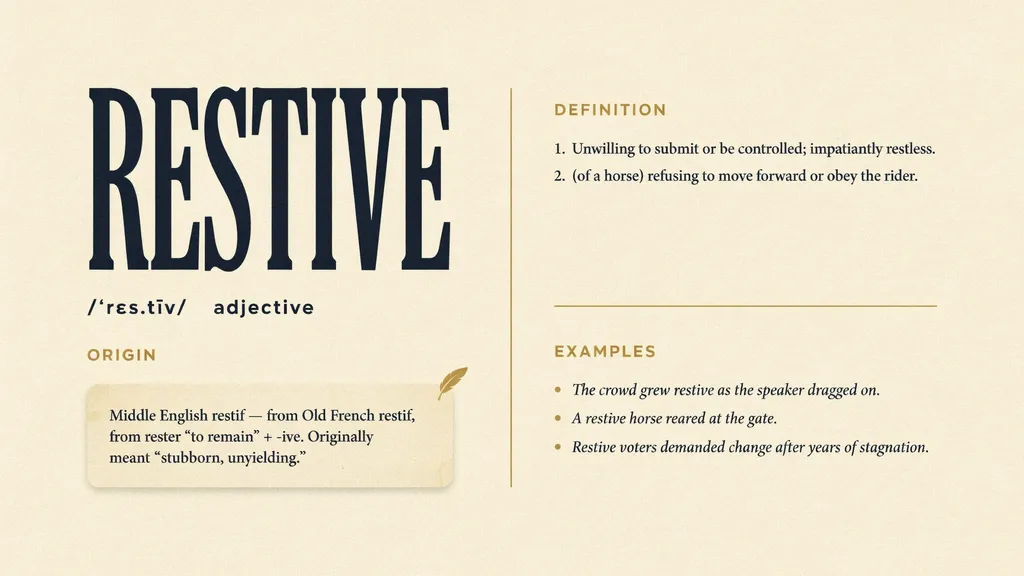
At the core, restiveness is about unease and impatience, plus this extra undertone of resisting control. So it can describe people, groups, animals, or even a whole political or social situation, when everyone starts feeling squeezed , stuck, done waiting , or just tired of being managed.
You’ll see it like: the audience gets restive. Or a restive crowd. Or a restive group that… somehow is not behaving in a nice, obedient way. It’s not that they turn totally blank or incapable, more like they get fidgety, tense, a little edgy. They might murmur more, get louder, lose patience, but the twist is that the restriction itself is part of what’s making everything worse.
A dictionary-style split, like Merriam-Webster, usually points to two closely related senses:
- Stubbornly resisting control (unruly , balky, hard to manage)
- Showing impatience or uneasiness (edgy, on edge, fidgety)
In everyday talk, most folks mainly mean that second sense. So if you hear “the crowd grew restive,” it basically means the crowd is getting irritated and agitated , not that they literally become chaotic things that can’t move at all.
How It Shows Up With Nouns
Restive tends to collide with nouns that suggest strain or pressure. Like: a restive crowd, a restive population, a restive market, a restive province.
Also it’s not only boredom vibes. Often there’s this friction feeling, like the system trying to keep things steady is now the problem, not just the waiting part.
Pronunciation (If You’re Wondering)
Restive is pronounced REH-stiv (/ˈres.tɪv/), and the stress hits on the first syllable.
Tiny memory trick: it kinda rhymes with festive. Which is funny, because festive is upbeat and restive is the opposite mood, so your brain remembers it more easily.
Where “Restive” Comes From
Ok this section always trips people a bit. The word shows up in English around the early 1400s as restif or restyffe, and it traces to Old French restif, meaning “motionless” or “brought to a standstill.”
Then Old French points back to the French verb rester, meaning “to remain.” That connects to the same family as rest and arrest.
In the earliest meaning, a “restive” horse was basically one that would not move. Like hooves planted , just staying there, no forward motion. Not the modern idea of a nervous, hard-to-handle horse.
So How Did It Flip?
Sometime around the 1680s, “restive” started shifting toward the idea of refusing to stand still, especially in horses. Some word-history folks suggest it happened because if a horse wouldn’t go, people treated it as “unmanageable” or as “impatient under restraint.” Over time, that resistance-to-control idea overtook the older motionless meaning.
And honestly, restless probably helped confuse things, and speed the whole swap along a little, even though restless is a totally different word, different lane, still not the same meaning.
By the 19th century, restiveness widened beyond horses to people, crowds, and bigger groups acting impatient or stubborn under pressure. And that’s what most people use now.
Restive vs. Restless (Why Everyone Mixes Them Up)
This is probably the whole reason you’re here, and it’s worth clearing up in plain terms, because the similarity is… annoyingly close.
| Restive | Restless | |
| Core meaning | Impatient specifically under restraint or delay | General inability to stay calm, still, or settled |
| Typical trigger | Waiting, imposed control, discipline | Anxiety, boredom, excess energy, insomnia |
| Implies resistance? | Yes often edges toward defiance | Not necessarily |
| Common subjects | Crowds, horses, regions, markets, electorates | Individuals, sleepers, minds, travelers |
| Example sentence | “The troops grew restive during the long ceasefire.” | “She spent a restless night tossing and turning.” |
A simple test is like, if the unease is coming from being held back, or forced to wait, then restive is usually the more accurate word, y’know, it has that sharper edge to it. If it’s more of a wider, more personal inability to settle down, with no real restraint involved, then restlessness just fits better most of the time, and honestly that difference kinda matters. Still, the two words overlap enough in casual speech that loads of people treat them like they’re the same thing, and yeah dictionaries often toss them together as near-synonyms, in the same little corner.
But professional writers and editors tend to keep that distinction, especially in journalism and political writing because restive has this extra layer of resistance that restless doesn’t always carry, or at least not in the same way, you know?
Synonyms of Restive
Depending on context, these can kind of stand in for restive:
Fidgety
Uneasy
Impatient
Agitated
Edgy
Jittery
Unruly
Balky
Unmanageable
Skittish, especially for animals
Chafing at restraint
Discontented
And if you need the single closest match, fidgety or uneasy are often the best bets, though “balky” is usually better when you mean stubborn resistance, not nervous impatience.
Antonyms of Restive
For the opposite vibe, reach for:
Calm
Docile
Tractable
Compliant
Placid
Content
Settled
Obedient
Patient
Tranquil
Restiveness: The Noun Form
Restiveness is basically the noun version of restive, and it describes the state or quality of being impatient, uneasy, or resistant to control.
“Growing restiveness among shareholders eventually forced the board to replace the CEO.”
You might also see it as an adverb, restively (“the horse shifted restively in its stall”), but it’s way less common in day to day writing, so, yeah.
How Restive Is Used in Real Context
A Restive Horse
This word’s original home, and it still shows up a lot in equestrian and veterinary contexts. A restive horse resists commands, refuses to stand still, pulls against the reins, or just plain fights for control. Trainers often say that restiveness in horses can come from fear, discomfort with tack, poor training, or simple temperament , and it’s rarely “bad behavior” with zero cause.
A Restive Region or Restive Area
In news and political writing, “restive region” is super common for territory with simmering tension, resistance to central authority, or the early stages of unrest, even when active conflict hasn’t really popped off yet.
“The government sent additional troops to the restive border province after weeks of protests.”
That usage comes up constantly in international coverage because it keeps the description tense, but doesn’t exaggerate it into full-on crisis language.
Grow Restive
“Grow restive” is one of the most frequent pairings with this word, meaning a slow build-up of impatience or unruliness over time.
“As negotiations dragged into a third week, both delegations began to grow restive.”
Restive Markets and Investors
Financial journalism often uses restives for investor anxiety tied to uncertainty, basically a more polished alternative to “panicky” or “jittery.”
“Restive investors pulled funds from emerging markets amid rising interest rate fears.”
Restive in the Bible
Restive isn’t a mainstream standard term you’ll see in common Bible translations, like the King James Version, the NIV, or the ESV. You might spot it in modern commentary, study guides, or paraphrase style translations describing Israel’s disobedience or spiritual rebellion, but it’s not tied to one specific verse or a consistent translation choice.
So if you’ve seen “restive” in a religious or devotional text, it was probably the author’s personal stylistic pick, to describe unruliness or discontent, not a direct “scriptural term.”
Restive in Other Languages
Since this word gets searched across multiple regions, here’s how the idea tends to translate across a few major languages. These are close conceptual equivalents, not exact legal or technical matches, because restive usually doesn’t land with one perfect word in most languages.
| Language | Closest Translation | Sense Conveyed |
| Hindi | अशांत / बेचैन (ashanti / bechain) | Unease, impatience |
| Urdu | بے چین (be-chain) | Restless, uneasy |
| Bengali | অস্থির (osthir) | Unsettled |
| Tamil | அமைதியற்ற (amaidhi yatra) | Without calm |
| Telugu | అశాంతమైన (ashantamaina) | Agitation, unrest |
| Malayalam | അസ്വസ്ഥമായ (ashwathama) | Disturbed, uneasy |
| Kannada | ಚಡಪಡಿಕೆ (chadapadike) | Fidgetiness, discontent |
| Marathi | अस्वस्थ (aswastha) | Uneasy, restless |
| Arabic | قلق / متمرد (qaliq / mutamarrid) | Anxious or rebellious, depending on context |
| Chinese (Simplified) | 不安的 / 躁动不安 (bù’ān de) | Uneasy, agitated |
Common Mistakes People Make With Restive
Mixing It Up With “Restful”
Mixing it up with “restful” . Like they look almost the same, but the energy is kind of the opposite. Restful is calm and peaceful, while restive on the other hand feels jammed-up , frazzled, agitated, and kind of like it’s not really up for staying put
Assuming It Always Means the Same Thing as “Restless”
Assuming it always means the same thing as “restless” . Restive is more pointed, it leans toward resistance, like not wanting to be steered or kept waiting. Restless is broader, it can be about feeling uneasy, without that same “can’t be restrained” vibe going on
Forgetting the Historical Pivot in Meaning
Forgetting the historical pivot in meaning. If you’re reading older or sort of archaic texts, remember the word used to mean “motionless” , which is basically the reverse of what most people assume today. So yeah it can throw you off, especially if you’re reading too fast
Misspelling It
Misspelling it. Common typo stuff includes “restitive” and “restivé” , and honestly this comes up a lot because the letters are so close in your head even when you think you’ve got it
Example Sentences to Cement the Meaning
“After the third flight delay announcement , passengers in the terminal grew visibly restive.”
“The restive colt refused to load into the trailer, no matter how gently the handler coaxed it.”
“Years of stalled economic growth left the population increasingly restive.”
“Restive board members began questioning the CEO’s long-term strategy.”
“The class grew restive in the final ten minutes before the bell.”
FAQs
What Is the Simplest Definition of Restive?
Restive means impatient, uneasy, or resistant to being controlled, or made to wait
Is Restive a Positive or Negative Word?
Mostly negative, or at least cautionary. It signals tension, pushback, or unrest, not something neutral
What Is the Difference Between Restive and Restless?
Restive usually implies impatience under restriction, delay, or control. Restless is wider, like general trouble keeping calm or staying still, with or without the whole restraint piece
What Word Is Nearest in Meaning to Restive?
Fidgety and uneasy are usually the closest one word cousins. “Balky” is a bit more similar when the point is stubborn resistance, more than nervous energy
Can Restive Describe a Country or an Entire Population?
Yes, “a restive population” or “a restive region” shows up a ton, especially in political and international news coverage. It’s describing simmering unrest or pushback against authority
What Does “Grow Restive” Mean Exactly?
It means the slow shift toward more impatience, unruliness, or resistance over time. Usually it’s tied to long waiting or ongoing restriction, so the pressure just keeps stacking
Why Does the Word Restive Contain “Rest”, If It’s Not Calm?
Because the original, 15th-century meaning was “motionless” , from Old French rester, “to remain.” It described a horse that refused to move. Then, over the centuries, it flipped toward “hard-to-control” behavior, and that sense is what people still grab today
Is Restive Used More in Spoken Conversation or in Writing?
It’s way more common in written English, especially journalism, political commentary, and literary fiction. In everyday speech people tend to choose other words, so restive can feel unfamiliar even for fluent speakers
Conclusion
Restive is a precise, slightly formal word for a specific kind of pressure: the impatience or unruliness that starts building when people , animals, or systems are held back, delayed, or restrained. The weird historystarting as “motionless,” then turning into “unmanageably restless”makes it one of English’s more surprising word origin stories
Once you get the difference (restive versus restless) , you’ll find it easier to use it correctly in writing, or even in conversation. Whether you’re describing a jittery horse, a crowded room that’s getting impatient, or yeah, an entire restive nation