
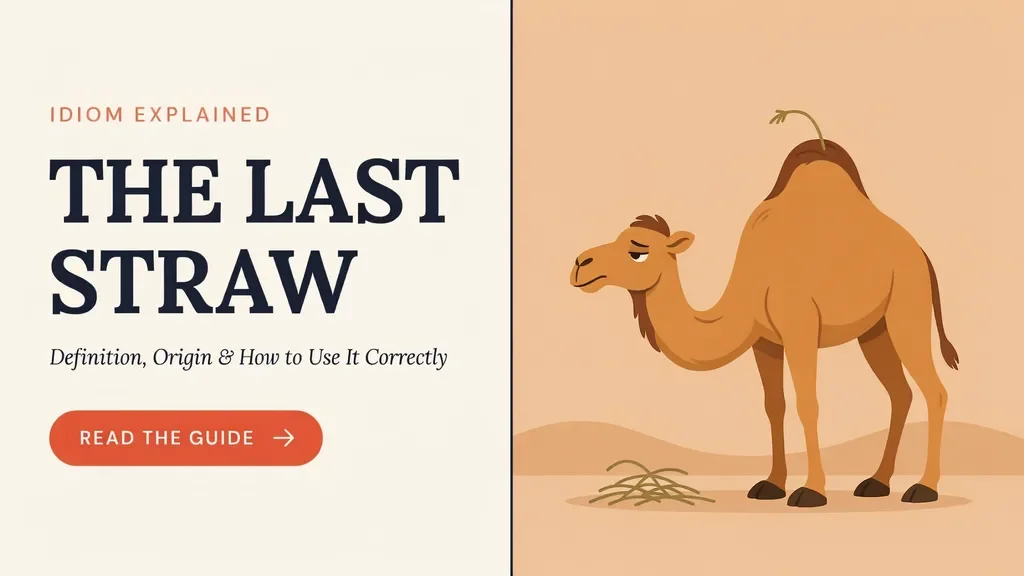
The last straw meaning is kinda simple, i mean it is like the final problem, annoyance , or setback that sort of nudges you past your limit of patience. It’s rarely the absolute biggest issue. It is more like the thing that comes in after many smaller ones, and then a person just goes yeah no, “That’s it. I’m done” , or something close to that.
If you ever quit a job, ended an argument, or finally cancelled a subscription after one more tiny irritation, you probably already get the whole idea. This guide explains the idiom from beginner level into a kind of higher use. You will see where it comes from, some sample sentences, the relationship angle and slang spins , plus synonyms, the typical goofs people make, and translations across several languages.
What Does “The Last Straw” Mean?
The last straw is an English idiom for the final event in a chain of unpleasant things that makes the situation feel impossible to handle anymore.
Here is the fast definition for quick looking:
The last straw (noun phrase , idiom): The last annoyance, mistake, or problem that makes someone lose patience, quit, or act in a decisive way.
Three ideas are kinda tucked inside this idiom:
Accumulation: A bunch of smaller troubles have already piled up.
A tipping point: One more issue slides across an invisible boundary.
A reaction: The person responds strongly, even if that last event alone feels a bit minor.
Also, the phrase is often shortened from the longer proverb “the last straw that breaks the camel’s back.”
The Last Straw Idiom Meaning: Quick Reference Table
| Feature | Details |
| Idiom | The last straw |
| Full form | The last straw that breaks the camel’s back |
| Part of speech | Noun phrase (idiomatic expression) |
| Core meaning | The final event that makes a bad situation unbearable |
| Tone | Informal to neutral; fine in writing and speech |
| Common verbs | Be, prove to be, become, turn out to be |
| Typical context | Work, relationships, customer service, politics, family |
| Emotion implied | Frustration, exhaustion, anger, resignation |
| Similar idiom | The final straw, the breaking point, the tipping point |
The Last Straw Meaning Origin: where does the idiom come from?
This idiom sort of comes from a common picture of an overloaded animal. You can imagine a camel hauling a heavy load. Each extra bit, like a straw, feels almost weightless, and still, at some point, one more straw is just… too much. Then the camel’s back gives out, I mean, breaks. Not because that one straw is massive, but because the whole pile before it already made the situation fragile.
The idea behind the image is that the last straw is not the only thing with “power”. The real damage comes from everything stacked earlier, bit by bit, until the final addition tips it.
A short history
Earlier English proverbs already leaned on similar kinds of images. Some versions from the 1600s talked about a feather as the final weight that breaks a horse’s back, which is kind of the same logic.
The camel and straw version shows up in English in the 1800s. It gets used by the novelist Charles Dickens in Dombey and Son (1848) , and that helps the phrase spread into wider use.
Over time, people trimmed it down, so “the last straw” became the usual way to say it. Today, most listeners don’t even think about the camel part, they just get the meaning.
Some websites still say there’s an ancient Arabic or Eastern origin for the camel story. That version is popular, but it is hard to pin down, so treat it like a possible influence, not as an established, confirmed fact.
Origin timeline table
| Period | Form of the saying | What changed |
| 1600s | “The last feather breaks the horse’s back” | Early English proverb about overload |
| 1800s | “The last straw breaks the camel’s back” | Camel and straw version becomes common |
| Late 1800s–1900s | “The last straw” | Shortened form used in everyday speech |
| Today | “The last straw,” “the final straw” | Used worldwide in English, in writing and speech |
How to Use the expression “The Last Straw” inside a sentence
People usually go with a few usual patterns, like,
“That’s the last straw.” (a quick reaction, kinda immediate)
“It was the last straw when …” (you tell the reason, what finally pushed it over the edge)
“[Event] proved to be the last straw.” (sounds more formal, or written)
“The last straw for me was …” (when it’s personal, you’re the one reacting)
Example sentences with “last straw”
“He forgot my birthday again. That was the last straw.”
“After three late deliveries the missing refund was the last straw, so I switched suppliers.”
“Her answer was the last straw . The manager asked her to leave the meeting.”
“The rent increase was the last straw for a lot of families in the neighborhood.”
“The cancelled flight was the last straw after a whole week of travel troubles.”
“The reservation mix-up turned out to be the last straw for the guests.”
“When the printer broke again, that would be the last straw for the entire team .”
Everyday use by situation
You can say it when something tiny-ish finally becomes the final problem, like when you’ve already had enough and then bam, one more thing happens.
| Context | Example sentence | Underlying build-up |
| Workplace | “Being asked to work another weekend was the last straw. I resigned.” | Long hours, no recognition |
| Customer service | “The third billing error was the last straw, so I cancelled my plan.” | Repeated mistakes, poor support |
| Family | “When he left the dishes again, it was the last straw.” | Repeated unshared chores |
| Politics | “The new tax was the last straw for voters.” | Years of discontent |
| Travel | “Losing my luggage was the last straw.” | Delays, bad weather, high costs |
Last Straw Meaning in a Relationship
In relationships, the last straw is that final, kinda small incident that makes someone finally decide to end it or demand a serious change. But it’s like, it doesn’t actually show up out of nowhere, surface wise it feels minor. Still, that moment is the one they can’t shrug off anymore.
Like, one partner might forgive missed dates, the “oops” promises, and those plans that never happen. Then, somehow, one more cancelled dinner happens, and then the breakup. That dinner isn’t really the full story. It’s more like the trigger, you know, the thing that tips it.
Common “last straw” moments in relationships
Repeated broken promises that stack up
Ongoing disrespect, or that constant dismissiveness
Lack of communication or effort over time
Dishonesty that shows up after earlier warnings
Feeling unheard, after raising the same concern, again and again, and it still gets brushed aside
Helpful perspective
To the other person, a “last straw” choice can feel sudden, like, boom done. But usually, the person making the decision has been carrying that weight for a long time. If you’re the one getting hit with the decision, try asking what has been building up, quietly. And if you’re the one reaching your limit , maybe it helps to talk earlier, before the little problems pile up and turn into something bigger.
This is just general communication guidance, not a swap for professional counseling. If the relationship involves abuse, or safety issues, please contact a qualified professional, or a local support service.
The Last Straw Meaning in Slang and Urban Dictionary
In casual talk, and places like Urban Dictionary, “the last straw” usually keeps the same meaning, but people often add a sharper, more emotional edge. You’ll see it in texts, social media posts, and group chats where the tone matters a lot.
Examples of slang-style use:
“Bro, he left me to read for three days. Last straw.”
“That’s the last straw, I’m unfollowing.”
“Okay that’s it. Last straw.”
You might also spot playful spins like “this is my last straw” or “last straw energy.” Still, the core idiom is “the last straw.” Those shortened or playful versions are informal, so they’re best avoided in more formal writing.
Last Straw Synonyms and Related Expressions
Want other ways to say the same idea? Here are solid alternatives, plus the small difference in how each one lands.
| Synonym / Related phrase | Meaning | Best used when |
| The final straw | Identical to “the last straw” | Any context |
| The breaking point | The moment someone can’t cope any longer | Emotional or stress situations |
| The tipping point | The moment a situation changes irreversibly | Social, political or business change |
| The limit | The point beyond which something is unacceptable | Everyday speech |
| The final blow | A last damaging event | Serious setbacks |
| The straw that broke the camel’s back | Full original expression | Emphasis, storytelling |
| The drop that made the cup overflow | The small addition that causes overflow | Similar idioms across languages |
| Enough is enough | A statement that patience is gone | Direct, spoken reactions |
A quick note on nuance: “Tipping point” is sort of neutral , and it can point to something good or something bad changing , while “the last straw” always drifts toward frustration, or it’s tied to a negative event that finally breaks things.
“The Last Straw” meaning in other languages
A lot of people end up searching for the last straw meaning in their own language. Most languages still have a comparable idiom , but the picture used can be a bit different. The translations under here are natural equivalents, not always word for word, and yeah they keep the same spirit even when the wording shifts.
| Language | Natural equivalent | Transliteration / note |
| Hindi | सब्र का बाँध टूटना / बर्दाश्त की हद | sabr ka baandh tootna (patience reaching its limit); “आख़िरी तिनका” is a literal rendering |
| Urdu | صبر کا پیمانہ لبریز ہونا | sabr ka paimana labrez hona (the cup of patience overflowing) |
| Bengali | ধৈর্যের বাঁধ ভাঙা | dhoirjer badh bhanga (the dam of patience breaking) |
| Tamil | பொறுமையின் எல்லை | porumaiyin ellai (the limit of patience) |
| Malayalam | ക്ഷമയുടെ നെല്ലിപ്പലക | kshamayude nellippalaka (the limit of patience) |
| Spanish | La gota que colmó el vaso | “The drop that filled the glass” |
| Chinese | 压垮骆驼的最后一根稻草 | yākuǎ luòtuo de zuìhòu yī gēn dàocǎo; the same camel image as English |
| English | The last straw | Standard form |
Interestingly, the Chinese one keeps the same camel and straw picture, while Spanish, Urdu and Bengali go with water, or like, overflow type images. Different cultures basically explain this same human experience but with different scenes, you know.
If you’re thinking of using these phrases in formal writing, it is smart to double check with a native speaker, because regional usage sometimes shifts.
Common mistakes with “The Last Straw”
A lot of search phrases show up around this idiom, like “pull the last straw,” “draw the last straw,” “hit the last straw,” and “take the last straw” and honestly people often get the verb wrong. Here’s what is actually correct.
. It’s not “pull,” “draw” or “hit”
The usual sentences are:
“That’s the last straw.”
“It was the last straw.”
“It proved to be the last straw.”
People don’t normally pull, draw, hit, or even take the last straw in the idiomatic meaning. Those verbs feel close, but they aren’t standard in this sense.
. Don’t mix it up with “drawing straws”
“Drawing straws” is a whole separate expression. It is about choosing someone randomly. People use straws that are different lengths, and whoever gets the short straw loses, or gets stuck with the annoying job.
“We drew straws to decide who would clean up.” , random selection
“The last straw was the final delay.” , idiom of frustration
And if someone literally drew the last straw from a set of straws, they’re just taking the final one in that list. That’s literal, not the idiom.
. Don’t say “broke” by itself, without the full setup
“The last straw broke” is incomplete, kind of like missing a piece. The complete version is “the last straw that broke the camel’s back” or “the straw that broke the camel’s back.” In everyday talk, most people just say “the last straw.”
Correct vs incorrect usage table
| Incorrect | Correct | Why |
| “He pulled the last straw.” | “That was the last straw.” | “Pull” is not the idiom’s verb |
| “This hit the last straw.” | “This was the last straw.” | The idiom uses “be,” not “hit” |
| “She drew the last straw.” (idiom meaning) | “That was the last straw for her.” | “Drew” suggests drawing straws |
| “The last straw broke.” | “The last straw that broke the camel’s back.” | Incomplete form |
| “It’s the last straw.” | “It’s the last straw.” | Always singular |
Last Straw vs Similar Idioms: Quick Comparison
| Idiom | Core idea | Emotion | Example |
| The last straw | Final trigger after many problems | Frustration | “The fee was the last straw.” |
| The tipping point | A moment of major change | Neutral | “Prices reached a tipping point.” |
| The final nail in the coffin | The event that ends something for good | Finality | “The scandal was the final nail in the coffin.” |
| The straw that broke the camel’s back | Full form of the last straw | Frustration | “That email was the straw that broke the camel’s back.” |
| Drawing the short straw | Getting the unpleasant task by chance | Resignation | “I drew the short straw and cleaned up.” |
How to Use “The Last Straw” in Writing: some Best Practices
Using idioms well can honestly improve your writing , but they do better in moderation , not every other sentence, okay.
Do
Use it when there’s a clear build up of earlier issues , like things stacking up slowly, not suddenly.
Give enough context so readers really see why that final event mattered , otherwise it lands flat.
Keep the idiom in the singular form: “the last straw.”
If you want a slightly more formal tone , choose “final straw” instead, but don’t change the meaning.
Don’t
Don’t use it for a one-time, first-time problem . (If it was the first, it’s not “the last.”)
Don’t overdo idioms, especially in academic writing or legal writing, since it can feel off.
Don’t mix it with unrelated verbs like “pull” or “hit” . It can sound mismatched, and the reader notices.
Pros and cons of using this idiom
| Pros | Cons |
| Vivid and easy to understand | Can sound informal in formal documents |
| Conveys build-up and emotion quickly | Non-native readers may not know it |
| Works in speech, fiction and journalism | Overuse can feel clichéd |
| Has many natural synonyms | The camel image may be confusing to some |
Step-by-Step: How to Write a Sentence with “The Last Straw”
Follow these steps to build a clear sentence.
| Step | What to do | Example |
| State the earlier problems | “The train was late, the meeting ran long, and my laptop crashed.” | |
| Introduce the final event | “Then the coffee machine broke.” | |
| Add the idiom | “That was the last straw.” | |
| Show the reaction | “I went home early.” |
The train was late , the meeting ran long, and then my laptop crashed. Like okay, i can handle it… but when the coffee machine broke, that was kinda the last straw, honestly i just went home early.
Why the Idiom Matters : the psychology behind it
This saying is almost like it’s syncing with what’s happening inside stress. People sometimes keep a smile on the early problems , real low key, until the whole load is starting to stack up too high. Then, some small thing jumps in, you know, out of nowhere, and it flips into this huge overreaction.
So yeah, someone can look like they’re doing too much, for something tiny. But really it isn’t about that little pebble on top. It’s about everything under it, that whole pile nobody watched.
How it helps to understand it
At work: Managers can notice the overload early, before an employee is already past the edge.
In relationships: Partners can raise small concerns before they keep building up like a pressure cooker.
In customer service: Companies can fix the recurring little annoyances, because customers often leave after the last straw , not after the first bump.
In personal life: You can sense your own stress climbing sooner, and set boundaries before you snap.
Frequently Asked Questions
What does “the last straw” mean?
“The last straw” is the final problem, or the last annoying moment, in a sequence of stuff , when it finally becomes too much. It’s what pushes patience all the way out.
Where does “the last straw” come from?
It comes from “the last straw that breaks the camel’s back.” The image is a camel carrying a heavy load, and then it just falls after one small extra bit is added. Earlier English versions used other pictures too, like a feather and a horse. But the camel version stuck, especially around the 1800s , even in writers like Dickens.
Is it “last straw” or “final straw”?
Both work, and they point to the same idea. “Final straw” can sound a bit more formal, but you don’t really change the meaning.
Can you give a quick sentence with “the last straw”?
Sure: “He ignored my message again , and that was the last straw,” and you can feel that build up, then the final click that ends patience.
What does “the last straw” mean in a relationship?
It’s the last incident that makes someone end things , or demand real change. Sometimes it seems small, but it arrives after a lot of unresolved issues already sat there.
What’s the difference between “the last straw” and “drawing straws”?
“The last straw” is about losing patience. “Drawing straws” is choosing someone by chance, where the short one gets stuck with the unpleasant task. So no, they’re not related at all.
What is the last straw meaning in Hindi and Urdu?
In Hindi, people might say things like “सब्र का बाँध टूटना” or “बर्दाश्त की हद.” In Urdu, a close equivalent is “صبر کا پیمانہ لبریز ہونا.” Both basically say patience hits its limit.
conclusion
The last straw meaning is simple enough to say, but it also gets used in a lot of ways. It’s the last trigger after a long build-up, not necessarily the biggest problem by itself. Once you know where it started , the right verbs, and when it fits, it becomes easier to use the idiom naturally, and avoid goofy slips like “pull the last straw” or “hit the last straw.”
Use it when there’s actually a history of frustration behind that last event. If you use it well, it can explain in a few words what might otherwise take a whole paragraph.