
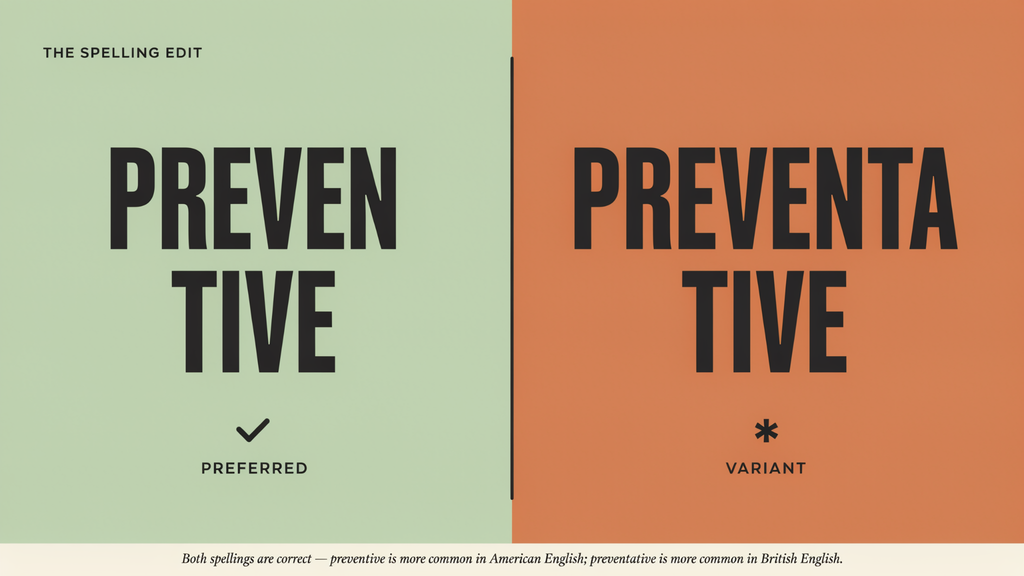
If you’ve ever paused mid-sentence wondering whether to write “preventive” or “preventative,” you’re not alone. Both words show up constantly on insurance paperwork, dental office signage, maintenance work orders, and health articles and seeing them used interchangeably can make you second-guess which one is actually correct.
Here’s the short version: they both are. Preventive and preventative mean exactly the same thing. The real question isn’t which word is right, it’s which one fits the context you’re writing in. And that answer changes slightly depending on whether you’re writing a formal report, filling out a health insurance form, or talking about your car’s maintenance schedule.
This guide walks through where each word came from, what style guides actually say, and how the terms play out differently across healthcare, dentistry, maintenance, and everyday writing.
The quick answer is, preventive and preventative are two ways to spell the same adjective, and both basically mean “ intended to stop something before it happens”. So, no, it is not a typo, and no, it’s not grammatically wrong either. Preventive is just the shorter one, it’s older too, and it’s way more common overall. That form lines up with AP Style, the Chicago Manual of Style and most dictionaries, which is usually what people mean when they say “ safe choice”. Preventative is not incorrect; it’s more like a rarer variant, you see it more often in everyday British English, or in casual speech, than you do in polished American writing.
If you still aren’t sure, and you don’t have a house style to follow, just default to preventive. It reads smoother, it’s more expected, and it will basically never look off, even if someone is picky about wording.
Where These Two Words Actually Came From
This whole preventive vs preventative confusion isn’t exactly new. It’s been in English for, like, nearly four centuries, baked in.
Preventive shows up first, around the 1630s. It comes from the Latin praevenire, which means “to come before” or “to anticipate,” plus the suffix -ive. Pretty straightforward, no big weird twists. Preventative arrives maybe twenty years later, in the 1650s. Instead of being built from the same root the same way, it kind of latches onto prevent and then adds the suffix -ative directly.
That likely happened by analogy with other, similar-sounding words like demonstrative and talkative. Most language historians describe it as an irregular kind of formation, not something that “broke” later. English already had a functioning word ( preventive ), and preventative developed beside it, without adding a brand new meaning.
That’s the key point, preventative isn’t a corruption or some mistake that sneaked into modern usage. It’s been a fully standard word for more than 370 years. You can find it in dictionaries like Merriam-Webster, and the Oxford English Dictionary, listed right alongside preventive, with no real usage warning attached.
Is There Actually Any Difference in Meaning?
Not really. I mean, no. This is worth saying right away, because it’s kind of the question most folks are really asking, but in a quieter way.
There isn’t a situation where one term means something and the other doesn’t. They both mostly work as adjectives, like “a preventive measure” and “a preventative measure” describe basically the same thing. Every now and then they can even show up as nouns too ( “a preventive against infection” , “a preventative against infection” ) , but that noun use is kind of rare in modern writing.
Just try switching them around in any sentence you want:
- “The company implemented preventive measures after the outage.”
- “The company implemented preventative measures after the outage.”
Both are fine, and a native English speaker will read them as the same idea , no special stress or extra nuance pushed one way or the other. Context doesn’t really force you into one version, it’s more like preference, honestly.
What Style Guides Actually Say
If you’re writing professionally, this is the part that matters most, because the style guide agreement is about as close to a “final answer” as you get on this topic.
| Style Authority | Preferred Term |
| AP Stylebook | Preventive |
| Chicago Manual of Style | Preventive |
| Garner’s Modern English Usage | Preventive |
| The New York Times | Preventive |
| Merriam-Webster | Preventive (notes preventative as valid but less frequent) |
| Oxford English Dictionary | Lists both, preventive marked as more common |
Is There Actually Any Difference in Meaning?
Not really. I mean, no. It’s worth saying right away, because it’s kind of the question most folks are really asking, but in a quieter way, I guess.
There isn’t a situation where one term means something and the other doesn’t. They both mostly work as adjectives like “a preventive measure” and “a preventative measure” pretty much describe the same kind of thing. Every now and then they can even show up as nouns too ( “a preventive against infection” , “a preventative against infection” ) but that noun use is kind of rare in modern writing, so you won’t see it all over the place.
Just try switching them around in any sentence you want:
- “The company implemented preventive measures after the outage.”
- “The company implemented preventative measures after the outage.”
Both are fine , and a native English speaker will read them as the same idea without any special stress, or extra nuance nudged one way or the other. Context doesn’t really force you into one version, it’s more like preference, honestly, even if it feels “slightly” different in your head sometimes.
What Style Guides Actually Say
If you’re writing professionally, this is the part that matters most, because the style guide agreement is about as close to a “final answer” as you get on this topic.
A Quick Regional Note
Word preference kinda shifts a bit depending on where your audience is, like it just depends. In the United States, preventive shows up as the dominant choice in professional and medical writing, by a pretty wide margin, while preventative feels more normal in casual talk. British and Australian English use preventative a little more often across general writing, even if most formal style guides over there still put preventive as the main option. So if you’re writing mostly for a U.S. audience, preventive is the safer default, in nearly every situation.
Preventive vs. Preventative Care
This is probably one of the most commonly searched versions of this kind of comparison, and honestly it makes sense because it pops up on insurance paperwork… constantly, it feels like.
Preventive care and preventative care mean the exact same thing: healthcare services made to catch problems early, or stop them from developing in the first place, instead of treating conditions after they’ve already moved along a bit.
Typical preventive care, usually includes:
Vaccinations and immunizations, helping protect against illness before exposure ever happens
Routine screenings blood pressure checks, cholesterol panels, cancer screenings like mammograms and colonoscopies, diabetes testing, bone density scans
Annual check-ups and wellness visits, ongoing monitoring even when nothing feels wrong
Chronic condition management, keeping things like high blood pressure or diabetes from getting worse
Lifestyle counseling, direction around nutrition, exercise, tobacco use and stress
Preventive care matters because a big portion of health complications in the U.S. including a lot of chronic issues are either preventable outright, or far easier to manage when they’re found early. That’s basically the whole reason routine screenings exist: catching something while it’s still small and manageable beats treating it after it’s become serious.
There’s also a practical financial side to this. Under the Affordable Care Act, many marketplace and employer-sponsored health plans are required to cover a defined list of preventive services at no extra cost to the patient, with no copay, no coinsurance, no deductible… as long as they’re delivered in-network. That’s the detail worth remembering, if you ever thought, “Why didn’t my annual physical bill create a bill”, but then a follow-up visit for a specific symptom did.
You’ll see both spellings floating around in insurer and provider materials, used back and forth like it’s no big deal, and that’s why so many people end up uncertain which one is “official.” The truth is neither one is really the only one.
Preventive vs. Preventative Maintenance
Outside healthcare, this kind of comparison shows up pretty constantly in facilities management, manufacturing, IT, and fleet operations. Same idea really, both spellings nudge at the same strategy, it’s a scheduled, proactive upkeep that gets done before equipment breaks down, rather than reactive fixes after something fails, you know .
Preventive maintenance (usually shortened to “PM” in industry circles) usually includes:
- – Scheduled inspections and regular servicing
- – Lubrication, calibration, and parts replacement based on a set interval or a usage trigger
- – Condition based monitoring, like vibration analysis or thermal imaging
- – Documented checklists and maintenance logs so there is accountability, traceability, all of that
There’s a reason “preventive” specifically tends to appear more in this area. Maintenance and reliability standards organizations, along with most maintenance-management software platforms, tend to default to “preventive maintenance” in their terminology, work order templates, and certifications. So if you’re setting up new documentation or software fields, matching that standard vocabulary helps keep things consistent across systems even if switching from an already established internal label isn’t strictly required.
It also helps to see how preventive maintenance sits alongside two related strategies:
| Maintenance Type | What Triggers It | Main Goal |
| Reactive maintenance | Equipment has already failed | Restore function after breakdown |
| Preventive maintenance | A fixed schedule or usage interval | Avoid failure before it happens |
| Predictive maintenance | Real-time sensor or condition data | Service only when data shows early wear |
Reactive maintenance is the most expensive long-term approach because failures tend to cause more damage and more downtime. Preventive maintenance sits in the middle proactive, but based on a schedule rather than real-time data. Predictive maintenance is the most advanced approach, relying on sensors and data trends to time service precisely, but it also requires more upfront investment in monitoring equipment.
Preventive vs. Preventative Dental Care
Dentistry is another area where both spellings pop up, sort of, but “preventive dentistry” and “preventive dental care” are, honestly, the more usual professional phrases you see in real practice
Preventive dental care generally includes Routine cleanings and check-ups, usually about every six months
Dental X-rays to catch decay before it’s visible or becomes painful
Fluoride treatments and sealants, especially for kids
Oral cancer screenings during normal visits
Guidance on brushing, flossing, and diet to reduce future trouble
The reasoning is kind of like general healthcare almost exactly, catching a small cavity during a routine cleaning is way cheaper and less unpleasant than waiting until it turns into a root canal. Regular dental visits are one of the clearest examples you can point to where preventive care really saves both money and discomfort later on.
Preventive medicine as a named specialty
So, here’s a thing that gets sort of talked around but not really nailed down in casual conversations: preventive medicine isn’t just some broad idea, it’s an actual medical specialty, like formally recognized. In the U.S. it’s board-certified, and that means it’s under the American Board of Preventive Medicine, and they focus on protecting and advancing health while preventing disease, disability and death. That part matters because it happens at both the person level and the whole population level.
Also, notice the spelling, it’s basically always written as “preventive medicine”, never “preventative medicine” in academic papers, clinical settings, and in government contexts. It’s one of those real-world patterns that sticks: when a subject becomes a named specialty, credential, or professional standard, it tends to settle on “preventive” rather than “preventative” and keeps that way
Preventive vs. Curative: a distinction that actually matters
Take a second here, because this feels like a totally different comparison from what came before, and blending the two up , is honestly one of those most common confusion things.
Preventive vs. preventative is more like a spelling choice. But preventive vs. curative, that’s something else, it’s a real and meaningful difference about when and why you take action, or at least why someone should act in the first place.
| Preventive | Curative | |
| Goal | Stop a problem before it starts | Treat or resolve a problem that already exists |
| Timing | Before symptoms, failure, or damage occur | After diagnosis or breakdown |
| Examples | Vaccination, routine screening, scheduled equipment servicing | Surgery, antibiotics for an active infection, emergency repair work |
A flu shot is preventive. Antibiotics prescribed after you’ve already caught an infection are curative. A scheduled equipment inspection is preventive. An emergency repair after a machine breaks down is curative. Keeping these two straight matters more, practically speaking, than which spelling of “preventive” you choose.
How to Decide Which Spelling to Use
If you want some easy way to settle this for your own writing run through this quick, basically.
Does your organization already follow a style guide?
Follow it. Most major style guides (AP, Chicago) recommend preventive. And honestly thats it
Is your audience primarily British or Australian?
Either word works fine though preventative may feel a bit more natural for that group.
Are you writing in a specific field, like medicine, dentistry, or maintenance?
Check how that field’s standard wording tends to lean, most of the time it defaults to preventive especially in formal documentation or official records.
No style guide, no strong regional signal , and you just want the safest choice?
Use preventative measures. It’s shorter, it is the dominant form in professional writing, and it will never look wrong.
Already using preventive consistently across existing documents?
Don’t switch mid-project just for the sake of it, consistency in a single piece matters more than which word you started with.
Common Mistakes You Should Not Do
A few small fumbles show up pretty often, and you can totally miss them at first, until it feels off:
Switching both spellings in the same document. . This is the one real slip here, because the inconsistency reads like a typo more than a plan or a choice, even though both words are correct alone.
Assuming just one spelling is automatically wrong, for no reason. Neither should be treated like an error by an editor or any spellchecker, they are both normal dictionary entries.
Getting preventive mixed up with preventative, like it’s the same idea. That’s not really it. These are two different comparisons one is about the word itself, and the other is about timing, intention, and “when it happens.”
Using the noun form too much, kind of overdoing it. “A preventive” as a standalone noun is still technically fine but it sounds a bit old fashioned in most modern writing. “Preventive measure” or “preventive treatment” feels much more natural, like it belongs in everyday writing.
Frequently Asked Questions
Is it “preventive” or “preventative”?
Both are correct, sort of. Preventive is the shorter one, and it’s used more, specially in formal, professional writing. Preventative is also totally valid, it just tends to pop up more in casual speech, and yeah it seems a bit more common in British English too.
What’s the difference between preventive care and preventative care?
Honestly there’s no real difference that matters. They both refer to healthcare services like vaccinations , screenings and check-ups, meant to catch problems early, or even help stop them before they begin.
Which is correct: preventive maintenance or preventative maintenance?
Both are fine grammatically, and they point to the same proactive maintenance plan. Preventive maintenance is the usual, industry-style phrase you’ll see in maintenance software, work orders, and technical documentation.
Does AP style prefer preventive or preventative?
AP Style leans toward prevention. It’s the one they prefer.
Is preventative a real word, or is it a mistake?
It’s real, standard English. It’s been around pretty much continuously since the 1650s. So no, it’s not a typo, not an error. Just the less common sibling of prevention, if that makes sense.
Why do two spellings exist for basically the same word?
Preventive showed up first, in the 1630s. Then, about twenty years later, “preventative” formed as another equally correct version, by adding a different suffix to “prevent.” They both stayed in use, and today they’re still considered standard.
Is preventive dental care the same thing as preventative dental care?
Yeah, same idea. It means similar services, like cleanings, X-rays, fluoride treatments, plus routine check-ups that aim to spot dental problems early.
What’s the difference between preventive and curative?
This one is actually different, unlike preventive vs. preventative. Preventive is about stopping something before it happens. Curative is about treating a problem that already exists, already there.
Is preventive care actually free under health insurance?
Under the Affordable Care Act, many U.S. health plans have to cover a set list of preventive services, annual check-ups, vaccinations, and some screenings are included with no copay , no coinsurance, and no deductible, as long as you get them in-network.
Conclusion
“Preventive” and “preventative” are both legit spellings of the same word, so none is really wrong, kinda depends on context and use. But if you want something to lean on, go with prevention. It’s shorter, and it’s what AP Style and the Chicago Manual of Style recommend. You’ll also see it more often in healthcare, dentistry insurance, and maintenance writing across the U.S.
Now, preventative isn’t an error, it’s just the less common variant. It shows up more in casual speech or in British and Australian English, that sort of thing, and you may notice it pop up that way.
The one rule that actually matters: choose one spelling and stick with it throughout your document, don’t switch midstream. Also don’t mix this up with preventive vs. curative. That comparison isn’t about how the word is spelled, it’s more about timing and purpose. It’s the split that changes what you’re describing, not letters on the page.