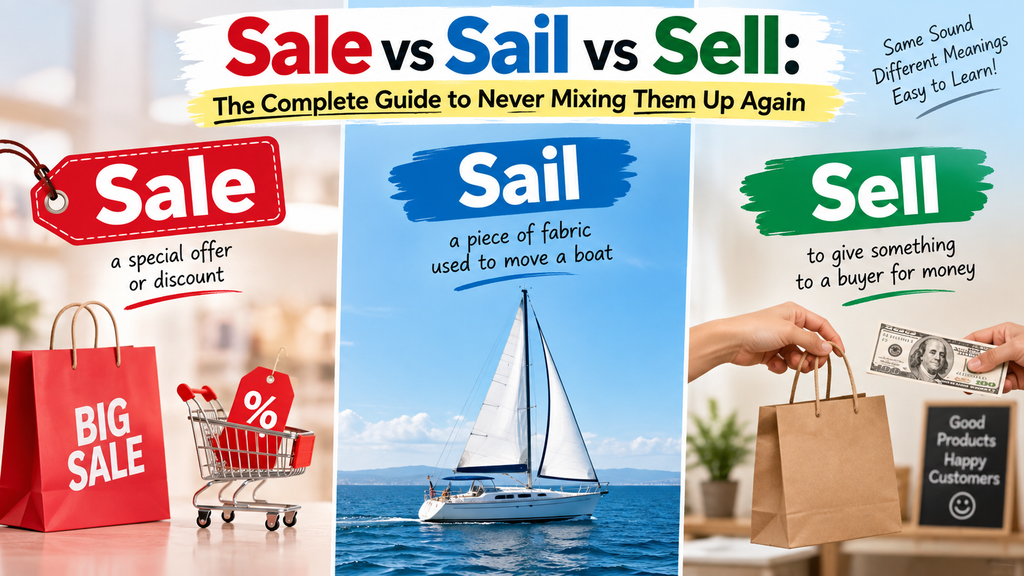
You’re typing fast, you hit send, and a second later you notice it: “The boat is for sale” came out as “the boat is for sail.” Or worse, it went the other way, and now your store’s weekend promotion is announced as a “sail.”
If that’s ever happened to you, you’re in good company. Sale and sail are two of the most commonly confused word pairs in English, and once you throw sell into the mix, things get even murkier. The good news is that the confusion is almost entirely about sound, not logic. Once you understand why these words trip people up, the mix-ups stop for good.
This guide breaks down what each word means, how to pronounce them, when to use each one, and how to catch the mistake before it catches you.
Why Sale and Sail Keep Getting Mixed Up
Sale and sail are homophones, two words that sound exactly the same when spoken but are spelled differently and mean completely different things. Say them out loud and you’ll notice there’s no audible difference at all: both come out as /seɪl/, rhyming with “pale,” “tale,” and “whale.”
This is exactly why the confusion happens. When you’re writing quickly, typing on a phone, or thinking in your head while composing a sentence, your brain often reaches for the sound of the word before it reaches for the spelling. If the sound matches two different words, it’s easy for the wrong one to land on the page.
There’s also a technical reason this mistake slips through unnoticed: spellcheck won’t catch it. Both “sale” and “sail” are correctly spelled, real English words. Your spellchecker isn’t checking whether you meant the right one, it’s only checking whether the word exists at all. That means a sentence like “the yacht is for sale” and “the yacht is for sail” will both sail (no pun intended) straight past autocorrect without a single red squiggly line.
This isn’t unusual in English. The language is full of homophone pairs that trip up even fluent speakers think of there/there/they’re, write/right, or flower/flour. Sale and sail belong to that same family of words: same sound, different job.
What Does “Sale” Mean?
Sale is a noun. It refers to the act of selling something, or to an event where goods are offered at a reduced price.
At its core, a sale is a transaction the exchange of goods or services for money. It’s the word you reach for whenever buying, selling, or discounting is involved.
You’ll see “sale” show up in contexts like:
- A discount event: “The store is having a summer sale.”
- A completed transaction: “The sale of the house closed last week.”
- General availability for purchase: “That painting is for sale.”
- Business and finance: “Sales tax,” “point of sale,” “sales team,” “sales figures.”
Because sale is strictly a noun, it never changes form the way a verb does. You won’t see “saled” or “saling” if you need an action word describing the act of selling, that’s a signal you actually need to sell, not sale. This is one of the most common writing slips even among people who never confuse sale with sail.
Common Phrases Using “Sale”
- For sale
- On sale
- Clearance sale
- Point of sale (POS)
- Sales tax
- Garage sale / yard sale
What Does “Sail” Mean?
Sail does double duty in English; it works as both a noun and a verb, and both meanings are tied to boats, water, and wind.
As a noun, a sail is the large piece of fabric attached to a boat’s mast that catches the wind and pushes the vessel forward. “The wind tore the sail during the storm.”
As a verb, to sail means to travel across water using a boat, or more broadly, to move smoothly and effortlessly even in situations that have nothing to do with actual water. “We sail to the island every August” is literal. “She sailed through the exam” is figurative, meaning she got through it easily.
Related Word Forms
| Form | Example |
| Sailing | “Sailing is her favorite hobby.” |
| Sailed | “They sailed across the Atlantic in 1998.” |
| Sailor | “Her grandfather was a sailor for thirty years.” |
| Sailboat | “We rented a sailboat for the weekend.” |
Common Phrases Using “Sail”
- Set sail
- Smooth sailing
- Sail close to the wind
- Sail through (something)
If a sentence involves boats, water, wind, or effortless movement, sail is almost always the right word and it’s the one clue that reliably separates it from sale, which never touches any of those ideas.
What About “Sell”?
This is where a lot of guides stop short, but “sell” is just as important to get right, especially since it sounds nothing like the other two.
Sell is a verb. It means to give something to someone in exchange for money. Where sale is the noun that names the transaction, sell is the action that creates it.
- Present tense: “I sell handmade candles online.”
- Present participle: “She’s selling her car this week.”
- Past tense: sold not “selled.” Sell is an irregular verb, meaning it doesn’t follow the standard “add -ed” pattern that regular verbs do.
Here’s the relationship in one line: you sell something, and the transaction itself is called a sale.
| Tense | Form | Example |
| Present | sell / sells | “They sell furniture downtown.” |
| Past | sold | “They sold the furniture last month.” |
| Present participle | selling | “They are selling the furniture now.” |
| Related noun | sale | “The sale of the furniture was quick.” |
Mixing up sell and sale is a different kind of mistake than mixing up sale and sail. It’s not a sound problem sell is pronounced /sɛl/, like “bell,” and doesn’t sound anything like sale or sail. It’s a grammar problem: using a noun where a verb belongs, or vice versa. “I want to sell my car” is a mistake people make surprisingly often, even native speakers, simply because sale and sell look and feel related.
Sale vs Sail vs Sell: Quick Comparison Table
| Word | Part of Speech | Pronunciation | Core Meaning | Example | |
| Sale | Noun | /seɪl/ (like “pale”) | Selling event or transaction | “The shoes are on sale.” | |
| Sail | Noun / Verb | /seɪl/ (like “pale”) | Boat’s fabric sheet; to travel by water | “We sail every summer.” | |
| Sell | Verb | /sɛl/ (like “bell”) | To exchange goods for money | “I want to sell my bike.” |
Notice that sale and sail share an identical sound, while sell stands apart phonetically. That’s the key distinction to hold onto: the sale/sail confusion is about hearing, while the sale/sell confusion is about grammar.
Pronunciation Breakdown
If you’re unsure how to say any of these words out loud, here’s the simplest way to check yourself:
- Sale rhymes with pale, tale, and whale.
- Sail rhymes with pale, tale, and whale identically to sale.
- Sell rhymes with bell, tell, and well, a completely different sound.
This matters for more than just speaking. If you’ve ever used a voice assistant to check a word, asking “how do you pronounce sail” will give you a sound that’s indistinguishable from “sale.” The spelling is doing all the work of carrying the meaning the sound alone won’t tell you which word is correct.
Real Example Sentences
Seeing the words in full context is often the fastest way to lock in the difference. Here are natural examples for each:
Sale:
- The furniture store is having a weekend sale.
- The sale of the company was finalized in March.
- These jackets are 40% off everything’s on sale.
- Sales tax varies depending on the state.
Sail:
- The old ship’s sail was torn during the storm.
- We’re planning to sail to the island tomorrow morning.
- Her presentation sailed through without a single objection.
- The sailor checked the ropes before setting sail.
Sell:
- I need to sell my old laptop before I move.
- This bakery sells out of croissants by 9 a.m. most days.
- They sold their house last year and moved to Texas.
- She’s been selling handmade jewelry online since 2022.
Common Mistakes (And How to Fix Them)
These mix-ups show up constantly in product listings, emails, social captions, and even professional writing. Here’s what they look like and the fix.
- “The shop is having a sale this weekend.” → “The shop is having a sale this weekend.”
- “We went for a sale on the lake.” → “We went for a sail on the lake.”
- “I want to sell my car.” → “I want to sell my car.”
- “This boat is for sailing.” → “This boat is for sale.” (unless you’re literally offering the fabric sail itself)
- “She sold her painting last week.” → “She sold her painting last week.”
Notice that most of these errors happen in exactly the situations where speed matters: quick emails, fast social posts, mobile typing which is precisely when your brain leans on sound instead of spelling.
How to Decide Which Word You Need
When you’re mid-sentence and unsure, run through this quick mental checklist:
- Is the sentence about boats, wind, or traveling on water? Use sail.
- Is it about a discount, a shop event, or a completed transaction (as a noun)? Use sales.
- Is someone actively doing the exchanging? Is it an action? Use sell (or sold/selling depending on the tense).
- Still stuck? Try swapping in a placeholder word. If “boat trip” fits, it’s sail. If “discount event” fits, it’s a sale. If “to trade for money” fits, it’s sold.
This method works because it forces you to check meaning instead of sound which is exactly where the mistake originates in the first place.
Simple Tricks to Remember the Difference
A quick memory anchor is often more useful than a grammar rule, especially in the moment you’re actually writing.
- Sail has an “i,” like in wind. Sailing involves wind, and the word “sail” contains that same letter as a small but effective visual hook.
- Sale rhymes with a store sign. Picture a red “SALE” sign in a shop window; it’s always spelled with an “a,” never an “i.”
- Sell is the action, sale is the result. You sell a house; the transaction afterward is called the sale. If the word is doing something (an action), it’s sell.
- Boats belong to the sail’s world; shops belong to sale’s world of sales. Keeping the two “worlds” separate in your head water versus commerce is often the fastest fix of all.
Why Relying on Spellcheck Alone Doesn’t Work Here
It’s worth repeating because it’s the single biggest reason this mistake survives in published writing: spellcheck tools flag misspelled words, not wrong-but-correctly-spelled words. Since sale, sail, and sell are all real, properly spelled English words, none of them will ever get flagged just for being used in the wrong context.
Some newer, more advanced grammar tools do attempt to catch context-based errors like this by analyzing the sentence around the word, but they’re not perfect and shouldn’t be your only line of defense. The most reliable method is still a quick manual read-through, specifically checking meaning rather than skimming for red underlines.
Other Words People Often Confuse With “Sale”
Sale sits in a small cluster of words that create similar confusion, either through sound or through meaning:
- Sale vs Sail homophones, identical pronunciation, covered in depth above.
- Sale vs Sell noun versus verb, same root idea (a transaction) but different grammatical roles.
- Sale vs Sold sale is the noun/event, sold is the past-tense verb form of sell.
- Sell vs Sale vs Sail the full trio, and the one most worth memorizing together since all three appear constantly in shopping, business, and everyday writing.
Understanding this small cluster as a group, rather than memorizing each word in isolation, tends to make the difference stick much faster.
Frequently Asked Questions
Is sail and sale the same word?
No. They’re homophones, meaning they sound identical but are spelled differently and carry completely different meanings. Sail relates to boats and water travel; sale relates to selling or discounts.
What is the difference between sale and sell?
Sale is a noun describing the transaction or event itself. Sell is a verb describing the action of exchanging something for money. You sell an item, and that transaction becomes a sale.
How do you use sail in a sentence?
Use sail whenever you’re referring to boats, water travel, or the fabric that catches wind on a ship for example, “We plan to sail across the bay this weekend.”
How do you use sale in a sentence?
Use sale for shopping, discounts, or a completed transaction, such as “The store is having a clearance sale” or “The sale of the property was finalized yesterday.”
Why do sales and sail sound the same?
Both words are pronounced /seɪl/ in standard English, making them classic homophones. The identical sound is simply a feature of how these two words evolved in the language, despite having entirely unrelated meanings.
Is sell pronounced like sale?
No. Sell is pronounced /sɛl/, rhyming with “bell,” while sale and sail are both pronounced /seɪl/, rhyming with “pale.” Sell doesn’t share a sound with either of the other two words.
What is the past tense of sell?
The past tense of sell is sold, not “selled.” Sell is an irregular verb, so it doesn’t follow the usual “add -ed” pattern.
Can sail ever mean the same thing as sale?
No, never. Even though they sound identical, their meanings never overlap. One is always tied to boats and water; the other is always tied to selling and money.
What’s the easiest way to stop mixing up sale and sail?
Focus on meaning instead of sound. Ask yourself whether the sentence is about water and boats (sail) or about selling and shopping (sale). Pairing each word with its “world” ocean versus store is usually enough to keep them straight.
Final Thoughts
Sale, sail, and sell are three small words that carry a surprisingly large amount of confusion, mostly because two of them sound completely identical and the third is easy to mistake grammatically. But once the distinction clicks sale is the noun tied to selling, sail is anything to do with boats and water, and sell is the action that creates a sale the mistake tends to disappear for good.
The next time you’re typing quickly and pause on which one to use, run through the simple check: is it about water, is it about a discount, or is it an action someone is doing? That one question will get you to the right word almost every time.