
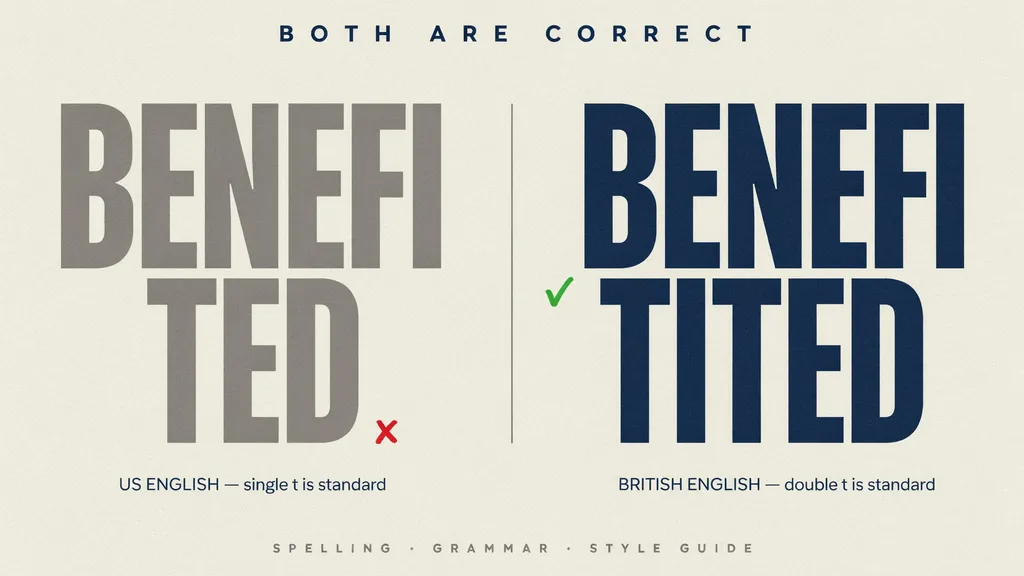
If you’ve ever typed “benefitted” , then you suddenly see that annoying red squiggly line under it and you start thinking maybe your spell-checker is off or maybe it’s you well, you’re not alone. This is one of those words that kinda looks like it should have a double “T”, the same vibe as “travelled” and “cancelled”, but for some reason it doesn’t always.
Here’s the short answer: “benefited” with one “T” is the standard spelling in American English , and it’s the version most major dictionaries list first. “Benefitted” with two Ts is not exactly wrong, it’s a legitimate variant, mostly showing up in British and Australian writing, however if you’re producing business content for a US audience, “benefited” is the safer, more professional default.
That quick line fixes the immediate issue. But if you write for a living , or you’re the person in charge of your company style guide, it helps to know why this word acts the way it does, because the same reasoning shows up across a lot of other terms your team probably reconsiders more than you think.
“Benefited” is basically the past tense and past participle of the verb benefit,
so it’s kind of about getting an advantage, or getting a hand from something, right. And yep, the way it shows up is pretty much what you’d expect, like it just turns up in the sentence where you normally slot it in.
The agency benefited from a stronger Q3 pipeline
Our clients have benefited from the new onboarding process
In grammar terms it behaves like a normal verb too. There’s nothing especially strange about the moving parts, it just sort of appears where you’d normally put it, and honestly the main debate is spelling.. kind of. I mean you already know that, yes?
Now, “benefitted” means the identical thing and it does the identical job in a sentence as well. It isn’t a totally different word, not a different tense, and not a different use pattern, it’s just another spelling. This version is more common in British, Canadian, and Australian writing, especially in older or more formally styled text. Sometimes people use it almost by habit, you know, when the document feels “classic”
The regional office benefitted from the merger
So if you’ve read older British business publications, contracts ,or academic papers you’ve probably seen that spelling at least once and not even really stopped to notice it. That’s the deal with accepted variants, they don’t really “look wrong”, they just quietly suggest there’s a different regional convention in play, and that’s about it.
The rule behind it (and why it really actually matters)
Most English spelling mix ups with doubled letters kind of come down to one main thing, when you tack “-ed” or “-ing” onto a verb you only double the last consonant if the stress ends up on that very last syllable, not the one before it.
Just try saying “benefit” out loud. The stress lands on the first beat, BEN e fit, not at the end. Since the stress isn’t on the last syllable, the usual spelling convention says “don’t double” that consonant. So you write “benefited” not “benefitted”. I mean it, you hear it, right.
Now look at “refer.” Say it again, re FER. In this case the stress sits on the final syllable, so when you add “-ed” you double that consonant: “referred.” Same general idea, sort of, but the result flips because the stress rhythm is different, like this.
| Word | Stress pattern | Doubled when conjugated? | Result |
| benefit | BEN-e-fit (first syllable) | No | benefited |
| refer | re-FER (final syllable) | Yes | referred |
| visit | VIS-it (first syllable) | No | visited |
| admit | ad-MIT (final syllable) | Yes | admitted |
This is honestly genuinely useful , beyond this one word. Like once you know the rule, you don’t really have to memorize each tiny exception, you just say the word out loud and then listen for where the stress lands, kind of naturally. So then why does “benefitted” even exist , if the stress rule says it shouldn’t? Mostly it’s just a historical habit . In British English, at various points, they duplicated final consonants a bit more freely than the stress pattern strictly demands , with the same instinct that also gives us “travelled,” “cancelled,” and “modelled” in the UK. And none of those follow the final-syllable-stress pattern either. So “benefitted” is basically a holdover, from that same tendency, not some separate rule that stands on its own.
Benefited vs. Benefitted by Region
If you’re pushing content into a certain market, or you’re keeping a style guide steady across regional teams, here’s how it kinda sorts out, in real life.
United States
In American English, you use only “benefited.” Style guides that a lot of US journalism and business writing teams lean on, AP Style and Chicago Manual of Style for instance, treat “benefitted” as nonstandard. So if your content is aiming at a US audience, “benefitted” will probably get flagged by an editor, a grammar checker, or a very attentive client.
United Kingdom
British English technically allows both, but the “current wave” has moved. “Benefited” is now the more common spelling and it’s increasingly the one recommended in modern UK publishing, including large outlets and common style guides. “Benefitted” still shows up, especially in more traditional, maybe slightly formal writing, but it feels like the older choice rather than the default.
Canada
Canadian English kinda lands in the middle, like it often does. “Benefited” is the form more people use and the one most commonly recommended, even if “benefitted” doesn’t look totally off in Canadian context, since Canadian spelling habits usually tilt toward British conventions elsewhere (colour, travelled, stuff like that).
Australia
Australian style guides , including the Macquarie Dictionary, generally prefer “benefited” too, and they follow the same stress-based logic you see in modern British usage. “Benefitted” is still recognized, but it’s just less frequent.
Quick regional reference:
| Region | Preferred spelling | Is the alternate spelling acceptable? |
| United States | benefited | No treated as a misspelling |
| United Kingdom | benefited | Yes, but less common today |
| Canada | benefited | Yes, occasionally used |
| Australia | benefited | Yes, occasionally used |
The pattern across all four major English speaking markets points the same direction: “benefited” is the safer, more universally correct choice, even in regions where the double T form is technically allowed .
What the Dictionaries Actually Say
It helps to know what the major dictionaries say, not just the vague “dictionaries list both” idea because the details matter more than that framing suggests
The Oxford English Dictionary puts “benefited” up as the primary form, and “benefitted” as a recognized secondary variant. It also says in plain terms that “benefited” shows up far more often in current usage, so yeah that’s not a small difference.
Merriam-Webster, which people treat like the default reference for American English, lists “benefited” as the only standard spelling. no extra wiggle room there.
Cambridge Dictionary lists “benefited” as the standard form, while “benefitted” is mentioned as a secondary British variant. so if you’re writing across regions, you can see why one would lean toward the first option.
And when a dictionary labels one spelling as “primary” and the other as “variant,” that’s honestly a helpful little signal for a style call. The primary form is the one that tends to read the right way for the broadest crowd and is the least likely to get second guessed.
Benefiting vs. Benefitting
That stress based logic still shows up with the “ing” form, and the regional story is pretty similar, too
Benefitting, with one T, is the standard in American English, and over time it’s getting more common in British , Canadian, and Australian writing as well.
Benefitting, with two Ts, is still accepted as a variant, but it’s used less often, mostly in older pieces or in more formal British and Australian text.
Employees benefiting from the new wellness stipend should confirm enrollment by the end of the month.
If you’ve already picked “benefited” for your style guide, then “benefiting” is the natural partner spelling so keeping both versions single-T helps the whole setup stay consistent across your content.
How This Shows Up in Business and Professional Writing
If you’re putting together content for work, like marketing copy, internal notes, client reports, press releases, it’s not just some trivia thing. There are a few practical moments where it kind of actually counts:
Style guide decisions. If your company hasn’t already picked a written preference, this is a good one to settle once ,and then park it in your style guide. Teams that don’t standardize usually end up with mismatched spelling sitting around in blog posts, slides, and client-facing documents. It looks careless, even though each example, by itself, is technically fine.
Client-facing content. If you’re writing for a US client or US audience , “benefitted” is very likely to get a raised eyebrow, a comment, or a correction even from someone who can’t quite explain why it seems off. “Benefited” just sidesteps the whole discussion.
Editorial and grammar tools. Most American grammar checkers, including the ones living inside word processors and common writing platforms , will flag “benefitted” like it’s wrong. So if your process runs drafts through automated proofing before publishing, going with “benefited” saves time and reduces the back-and-forth.
Cross-regional teams. If you’ve got editors or writers across the US, UK, Canada, and Australia, choosing one spelling for all official output, instead of letting it drift based on who typed the first draft, keeps published material looking uniform. And that matters, no matter where the writer is located.
A few, related word pairs you’ll run into
Once you get that stress based doubling rule down, a whole bunch of other word pairs that people second guess start to feel less random, really. It’s kinda odd at first but then it clicks , and you go “oh, wait.”
Travel / travelled: “travel” gets the stress on the first syllable, so under strict stress logic it shouldn’t double anything. still British English does anyway, like there’s a behind the scenes vibe showing up too with “benefitted” as well. American English goes with the single T , “traveled”.
Canceled / cancelled , looks like traveled/travelled in actual use: American English keeps a single T, while British English doubles it.
Modeled / modelled: again American keeps the single T, British uses the double T, and it fits with that regional habit not just the stress rule itself. Even though people say it’s all about stress.
The throughline is kinda this: American English tends to apply the stress rule more strictly, while British English has historically doubled certain consonants even when the stress isn’t right there in that spot. Once you recognize the pattern, you’re not memorizing a bunch of unrelated spellings, you’re just noticing one steady regional tendency.
Here are Common Mistakes to Avoid… kinda
This is a short list of the errors that actually show up in real content, you know the ones:
Switching spellings mid document. Using “benefited” in the introduction and then “benefitted” further down is probably the biggest one, and it’s super noticeable too, it’s also an easy catch if you do a quick find-and-check run before publishing.
Assuming every “-it” verb behaves the same way. “Benefited/benefitted” and “visited/listened” don’t follow identical rules, just because they share an ending. Always check the exact word, not just the pattern you remember from before.
Using “benefitted” by default because it “looks more formal.” But like, formality and correctness aren’t the same idea. “Benefited” tends to be the more standard option and it’s usually the more broadly professional choice.
Treating this like a hard grammar error rather than a style call when you’re writing for UK, Canadian, or Australian audiences. Outside the US, “benefitted” isn’t wrong, it’s just less common. So correcting someone else’s choice should be more of a style suggestion, not a full on grammar correction.
Quick Decision Guide
- If you need a quick rule you can actually use without going back and re-reading everything above every time: if you are writing for a US audience, or you simply don’t know who the audience is, then use “benefited.” That’s it, no over thinking.
- If you’re writing for the UK, Canada, or Australia, and the house style tends to favor the double-T form, then “Benefitted” is fine, but you should still check your specific style guide, just to be safe.
- Are you managing a team, or running a style guide? pick “benefited” as the default across all regions. it’s correct everywhere, and it removes that whole inconsistency issue in one move.
- No matter what you choose, stay consistent through the whole document, and apply the same single-T logic to “benefiting” too.
Frequently Asked Questions
Is “benefitted” a real word?
Yes , it is. It counts as a past tense form of “benefit” , you’ll mostly run into it in British and Australian English. It’s just less usual than “benefited,” which is the more common version you see in most major style guides, and in dictionaries to
Is “benefited” correct in British English?
Yes , and honestly it’s getting used more often lately. In modern British publishing they kind of lean toward the single-T route, even if “benefitted” is still mentioned, and you’ll still see it now and again
What does Oxford say is correct: benefited or benefitted?
Oxford lists “benefited” as the main spelling, and says it shows up much more in modern usage. It also puts “benefitted” as a secondary option, still valid , kinda
Do Americans ever use “benefitted”?
Almost never. If it does pop up , US style guides like AP Style and The Chicago Manual of Style treat it as a mistake, plus most grammar-checker tools will flag it too
What’s the difference between benefiting and benefitting?
It’s the same sort of energy as the benefited / benefitted split. “benefiting” (one T) is the usual everywhere, while “benefitting” (two Ts) is a rarer alternative you mostly spot in British and Australian writing
Why doesn’t “benefit” double its final consonant like “refer” does?
Because the stress in “benefit” lands on the first chunk (BEN-e-fit) not on the end. English doubles the final consonant before “-ed” or “-ing” mainly when the stress lands on the final syllable, so “referred” doubles but “benefited” doesn’t, full stop
Which spelling should a business or content team standardize on?
Go with “benefited”, across the board. It’s accepted in the US, UK, Canada, and Australia. It’s also the first thing listed in every major dictionary, and it keeps you from the weird mismatch where different writers pick different spellings, or different regions just wander in
Are “beneficial” and “benefit” interchangeable?
No , they aren’t. They’re not the same type of word. “Benefit” works as a noun or a verb for a gain, or the act of gaining (“this offers a real benefit,” “you will benefit from this”). “Beneficial” is an adjective meaning something that produces a benefit (“a beneficial arrangement”). They’re related, sure, but you can’t just swap them around inside a sentence without changing what it means
Conclusion
The whole spelling back and forth around “benefited” and “benefitted” really isn’t much of a debate once you know the rule. the stress in “benefit” lands on the first syllable, so that the last consonant doesn’t get doubled, and “benefited” is the spelling that matches it. It’s also the one most big dictionaries place first, and it’s the only option that shows up as accepted, across the board, in American English.
If you’re writing professionally the practical lesson is simple, go with “benefited” and “benefiting,” keep it steady through your pages, posts, decks, or any formal text. You can do that regardless of which English-speaking market you’re targeting, and then you won’t have to rehash this word ever again.