
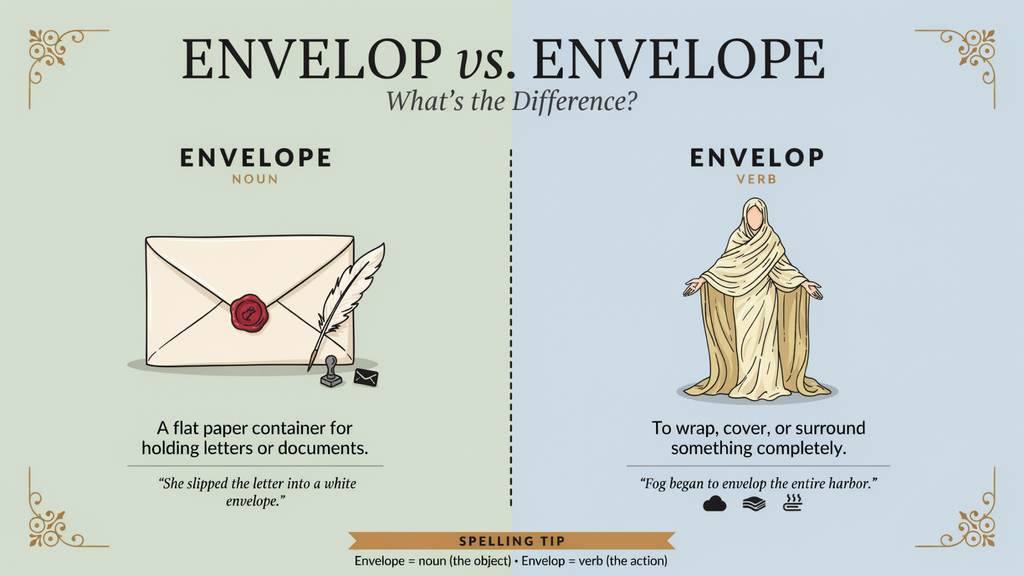
A gray mist slowly began to envelop the valley. Or was it an envelope? Kinda depends. If you’ve ever stopped mid sentence because you weren’t sure, you’re not alone. Even working writers pause, and spell-check won’t really help, since both forms are real, correctly spelled words in English.
The good part is, there’s a quick rule like ten seconds and once it clicks, you won’t mix them up again.
Envelop is a verb, a doing word, action stuff. Envelope is a noun. The word for the paper sleeve where you tuck a letter, you know the one you mail, is envelope (with an o). The word for how fog, smoke, or a dark chill wraps around a place is envelope (no it—no “o” there? wait, let’s not get tangled, the spelling is the important bit, without the extra letter that isn’t needed). They come from the same root, they look almost identical, and they sound nearly the same, but they do not swap roles.
So let’s sort out how each one works, step by step, with a clean side by side check.
Envelop vs. Envelope: Side-by-Side Comparison
| Feature | Envelop | Envelope |
| Part of speech | Verb | Noun |
| Meaning | To surround, cover, or enclose completely | A paper wrapper for letters or documents |
| Spelling | Ends in -el, no final e | Ends in -ope, with final e |
| Pronunciation (US) | en-VEL-up | EN-vuh-lohp |
| Plural | (verbs don’t have plurals) | envelopes |
| Verb forms | envelop, envelops, enveloped, enveloping |
BBoth words descend from the Old French envoluper, meaning “to wrap up.” English kind of borrowed the root twice, once for the action, once for the object, and the two words have traveled separately ever since, so it all feels off in a way. That’s the source of all the confusion : they’re essentially twins raised in different houses, you know.
The Core RuleObject vs Action
Okay so the Core Rule—Object vs Action—kind of comes down to like one simple question. Are you naming something, or are you doing an action type thing with the word? And it matters, because it’s not just vibes.
If you’re talking about a physical item, like a thing you can hold in your hand— then you’re talking about an envelope. You know, the sleeve that holds a birthday card, a contract, a wedding invitation. You put it in an envelope.
But if the word is doing the job of wrapping, covering, swallowing, or surrounding something— like fog, darkness, silence, warmth moving in— then you’re using envelope as the action, the verb. Like, it’s enveloping.
A few examples that kinda lock the difference in place:
She sealed the envelope and dropped it in the mailbox.
Darkness slowly enveloped the neighborhood.
I found three unopened envelopes on the counter.
A strange calm enveloped the room, after the announcement.
The 30-Second Substitution Test
When you’re already in the middle of an email and you can’t remember which form to use, don’t just guess and hope. Swap in another word and see what sounds right. Quick and low drama.
Try “package” or “sleeve” first. If the sentence naturally wants that noun, then you’re going to use envelope (the noun).
Then try “surround” or “cover.” If that works, then you’re probably using envelope as the verb, the one that surrounds.
Test it in action
“Please return the form in an.”
“In a package” works → envelope.
“Grief seemed to her.”
“Surround her” works → envelope.
And honestly, this little trick fixes like 95% of the real world mixups, because it makes you figure out what the word is doing in the sentence first, then spelling comes later, sort of.
How to Pronounce Each Word Kinda
- They sound close enough that just pronunciation alone usually won’t reliably separate them, but there is a difference and once you know it your ear starts catching weird mistakes when you read it out loud ya know
- Envelop (as a verb) : stress the second syllable en-VEL-up
- Envelope (as a noun) : stress the first syllable EN-vuh-lohp
- In fast casual American talk, the unstressed vowels kinda blur together , and that’s one big reason the spellings get mixed up so often in writing too . So don’t lean 100 percent on how it sounds, use the word’s role in the sentence instead
Plurals, Verb Forms, and the “Envelops” Trap
This is where most grammar pages end up leaving you kinda stranded so here we go, a bit more thorough
Plural
The plural of the noun is envelopes, always with the -es
- Correct : She found three envelopes on her desk.
- Wrong : She found three envelopes on her desk.
Verb conjugation
The verb keeps the usual patterns :
- Base form : Fear can envelop anyone.
- Third person singular : The fog envelops the harbor every morning.
- Past tense : Silence enveloped the hall.
- -ing form : An enveloping warmth spread through the room.
The trap : “envelops” is a real word
Here’s the subtle part that almost nobody spells out clearly : envelops is legit only as the third person singular verb , never as a plural noun thing . If your spell checker swaps “envelopes” for “envelops” it’s wrong and now you’ve got the why. Try saying the sentence out loud with “surrounds” instead of “envelops.” If it still works grammatically then the spelling choice is fine. But if you meant more than one mailing sleeve then it has to be envelopes
Spelling details worth memorizing
Two small rules that stop the common slips :
- The final p is never doubled : enveloped, enveloping not “enveloped” or “enveloppping.”
- Neither word is ever hyphenated or broken apart : “en-velope” and “en velope” are always wrong
Memory Tricks That Actually Stick (kinda)
If you need a mnemonic, use the letters themselves, O for Object. Like, an envelope is the object where you put a letter in. Think of the O as that round little opening, or sleeve, you know. Then E = Enclose or Engulf. An envelope is the action of wrapping around something. Picture the e as arms, closing in, sort of fast.
A quick pair to lock it in, because your brain likes pairs:
Envelope (object): The RSVP came in a cream-colored envelope .
Envelop (action): A hush enveloped the auditorium. (see, action doing the work)
Using Each Word Well: Tone and Context
First , spelling is half the job. Then using each word, for the right moment, is the other half. Business writing has one vibe, everyday talk another, and academic writing is picky in a very specific way.
In business and professional writing
The envelope is neutral and safe, anywhere: “Please sign and return the contract in the enclosed envelope.”
Envelop, by contrast, tends to sound literary or dramatic. “We are enveloped in uncertainty” reads like a novel, not like a project update .
So in normal workplace communication, plainer verbs usually do you better, honestly.
Instead of “The paperwork enveloped the audit team,” try “The audit team was overwhelmed by paperwork.”
Instead of “Envelop the checklist with the contract,” try “Include the checklist with the contract” or if you truly mean it literally, “Put the contract in an envelope with the checklist.”
In academic writing
Here, precision matters more than vibes. Envelope = the physical item, enveloped = what happened, past tense action: “A silence enveloped the lecture hall after the results were announced.”
Also , watch the subject , verb thing too. “a silence enveloped” works, not “a silence envelope” obviously.
In creative and descriptive writing
Okay, here’s where the envelope feels at home. Atmosphere, mood, immersion, all that stuff:
“When the downpour ended, thick, eerily swirling low clouds enveloped the valley.”
“Night enveloped the harbor , and the last ferries blinked out of sight.”
If your prose needs a verb that kind of swallows the whole scene, envelope is often the best fit, or at least a really solid one.
A practical rewriting tip, not too serious
Sometimes neither word sounds smooth, and that’s your signal to pause. If swapping in surround or package feels a little forced, then rewrite the sentence, fully, instead of stuffing the wrong word in and hoping nobody notices. Clarity wins over cleverness , almost every time, even when you really want the fancy effect.
Other Meanings You Should Know
Because “envelope” shows up in a few specialized areas, it’s smart to know the fixed ways people use it, as different nouns, sort of thing. Otherwise you read one sentence and assume it’s just mail, and then nope.
Building envelope
In architecture, construction, and energy efficiency , the building envelope is the physical shell, separating what’s inside from the outdoors. Walls, roof, windows, doors, foundation, insulation—basically, the whole boundary. People use “building envelope” this way, never “building envelope”, never as a verb or something like that. It’s a “thing” not an action. A tight building envelope means less drafts and less energy escaping, so you see it a lot in talk about heating costs, and green building criteria.
Pushing the envelope
This phrase means going past normal limits, or accepted boundaries, you know, pushing farther than you “should”. It’s tied to test-flight aviation, where pilots would push an aircraft right to the edge of its performance envelope, the chart-ish graph of safe operating limits. Engineers still use “envelope” the same way, like in “flight envelope”, which is basically a vehicle’s performance boundary.
Envelopes in music production
In electronic music, and audio engineering, envelope becomes a steady part of the workflow, again as nouns. Like :
An envelope generator, usually ADSR (Attack, Decay, Sustain, Release) , it controls how a sound’s volume changes over time.
An envelope follower, which listens to an incoming signal and turns loudness into a control voltage.
An envelope filter, think classic auto-wah style, that’s commonly driven by an envelope follower.
A triggered envelope, which just means the envelope starts when it gets an outside trigger signal.
Envelope sizes
If you’re mailing things in the US, a couple sizes show up all the time:
#10 (also called Com 10): 4 1⁄8 × 9 1⁄2 inches, it’s the typical American business envelope size, so a letter folded in thirds slides in cleanly.
DL (110 × 220 mm): the international standard, pretty common in Europe and South Asia, made for A4 paper folded into thirds.
You’ll also see booklet envelopes, they open on the long side and work well for brochures, catalogs, and that sort of printed matter. Catalog envelopes open on the short side, with a center seam that’s sturdier for heavier content. For shipping, padded poly envelopes include bubble lining for extra protection, while plain poly envelopes are just lighter plastic mailers, no extra cushioning.
Enveloped viruses
In biology, an enveloped virus is basically a virus that’s wrapped in a fatty membrane borrowed from the host cell it came from. Influenza, HIV, and coronaviruses—those all do this. That’s also why they’re more vulnerable to soap. Here the “envelope” is the virus’s outer wrapper, a physical outer boundary again, just in a different context.
Common Mistakes (and Quick Fixes)
| Wrong | Right | Why |
| I mailed it in an envelop | I mailed it in an envelope | Mailing sleeve = noun = -ope |
| A mist envelope the valley | A mist enveloped the valley | Action needs the verb and past tense |
| Three envelopes on the desk | Three envelopes on the desk | Plural noun takes -es |
| Enveloping fog | Enveloping fog | The p is never doubled |
| The building’s envelop | The building’s envelope | Technical noun, always -ope |
| Please envelope the report | Please attach the report | Wrong word role or say “put it in an envelope” |
When in doubt, do the substitution test. And if the swap feels a bit awkward even when it’s technically correct, treat that as a signal to rewrite with a plainer verb, rather than forcing it, ok?
Why Spell Check Won’t Save You
This pair shows off one of the biggest weak spots in automated writing tools. Spell-checkers only confirm that a word is in the dictionary, not that it’s the right word for the job. Since envelope and envelope both exist as real entries, your software will gladly switch one for the other and just call it “fixed” then move on.
Grammar tools that look at a word’s job in the sentence—like whether it’s acting as a subject, object, or a verb—catch these problems more reliably. Still, the most dependable checker is usually the one in your own head: ask “thing or action?” before you type.
Words Often Confused, In the Same Sorta Way
Once you’ve got this object-vs-action logic down, it tends to handle a lot of English’s sneakier near-duplicates
affect (verb) / effect (noun)
complement (something that finishes, completes) / compliment (praise)
cite (a reference) / site (a location) / sight (vision)
imply (the speaker suggests) / infer (the listener concludes)
stationery (writing materials) / stationary (not moving)
One test, many words.
Frequently Asked Questions
Is envelope a noun or a verb?
Envelope is always a noun, it’s that paper sleeve you use to mail letters, documents . The verb form, which is basically “surround or cover,” is envelope , and it is spelled without the final e , for sure.
What is the plural of envelope?
Envelop is a verb, so it doesn’t really have a plural. The plural of the noun envelope is envelopes . You might also see envelopes (like “Fog envelops the city each dawn.”) but that’s the third person singular verb, not the noun.
How do you pronounce envelope vs envelope?
The verb envelop usually lands on the second syllable, en-VEL-up. The noun envelope hits the first, EN-vuh-lohp. In quick conversation this difference can get sort of blurry though, so go by meaning, not by sound.
Is it “enveloped” or “enveloped”?
It’s always enveloping and enveloping . The last p never gets doubled before -ed or -ing, so no extra p weirdness, ok.
Is it correct to say “envelop you”?
Yeah, it is. “Envelop you” means to surround, or kind of engulf you, sometimes in a more poetic way: “A sense of peace seemed to envelop you as you watched the sunset.” So it’s doing its grammar job.
Is it “a building envelope” or “a building envelope”?
It’s building envelopes. The idea is the physical outer shell of a structure : walls , roof, windows, insulation, all that familiar stuff. That’s the noun lane.
Can envelop ever be used as a noun?
Nope. Envelop only works as a verb . Every noun-ish meaning area—mailing sleeve, building shell, flight limits, virus membrane, sound shaping curve—goes with an envelope.
What does “pushing the envelope” mean?
It means testing, or going past the usual, conventional limits. The phrase comes from aviation, where a test pilot would push an aircraft toward the edge of its performance envelope, basically the boundary of safe operation.
Why does spell-check keep changing my word to the wrong one?
Because envelope and envelope are both legit words in the dictionary. Spell-checkers tend to focus on spelling, not meaning, not sentence logic . Do a quick swap test: replace the word with “package” (for the noun envelope) or “surround” (for the verb envelope), and see what actually fits.
What’s an easy memory trick?
Think O = Object: envelope is the thing you can hold.
Think E = Engulf: envelope is the act of wrapping around something. If you can grip it, it’s O. If it’s performing the wrapping, it’s the other one.
Conclusion
This mix up still shows up because the words look almost the same, and they sound close enough that your brain goes “wait… maybe.” Also, spell-check doesn’t rescue you much , since it accepts both. Still, the core rule is pretty simple: envelope is the thing, envelope is the action.
Keep the substitution test close when you’re writing, especially when you’re under pressure. Remember envelops is the verb form, envelopes is the plural noun . And don’t force envelope/envelope into everyday business prose when a smoother option like “surround” or “include” works better. Lock in these habits, and this pair of troublemakers should stop tripping you up.