
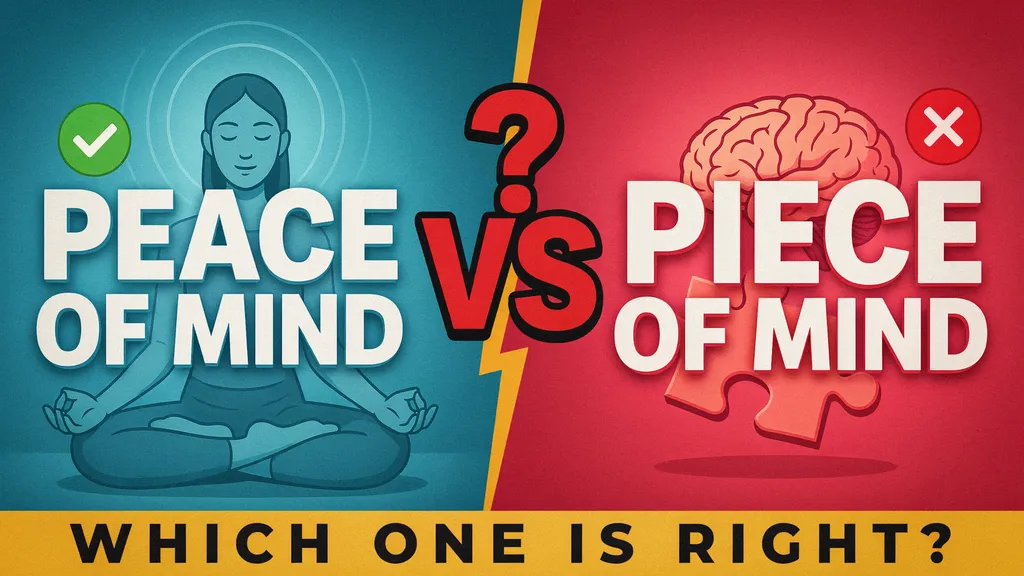
If you’ve ever paused mid-sentence wondering whether to type “peace of mind” or “piece of mind,” you’re in good company. The two phrases sound completely identical when spoken, which is exactly why so many people write the wrong one without ever realizing it.
Here’s the short version: peace of mind is the correct phrase. It describes a feeling of calm, security, and freedom from worry. Piece of mind, taken literally, would mean a physical fragment of someone’s mind which isn’t a real concept and almost never fits what the writer actually means.
The confusion isn’t really about grammar rules. It’s about sound. Peace and peace are homophones two words that are pronounced exactly the same but spelled differently and mean entirely different things. Your ear can’t tell them apart, so your fingers sometimes reach for the wrong one.
What “Peace of Mind” Actually Means
Peace of mind describes an emotional state: calm, reassurance, and the absence of worry or doubt. It’s what you feel after a problem gets solved, a risk gets covered, or an uncertainty finally gets resolved.
Think about the moments when people typically reach for this phrase:
After locking the front door before a trip
After a doctor confirms test results are normal
After buying insurance that covers a “what if”
After a hard conversation finally clears the air
In every one of these situations, something shifted from uncertain to settled. That shift from worry to calm is exactly what “peace of mind” names.
The word “peace” comes from the Latin pax, meaning tranquility or the absence of conflict. It’s been paired with “mind” in English since at least the 1500s, consistently used to describe an internal, emotional state rather than anything physical. That long, stable history is part of why dictionaries and style guides recognize only one correct spelling here.
Why “Piece of Mind” Doesn’t Work
“Piece” comes from a completely different root Old French pece, meaning a part, portion, or fragment. It’s the word you use for a piece of cake, a piece of furniture, or a piece of advice.
Swap it into “peace of mind” and the sentence stops making literal sense. “This insurance gives me peace of mind” would technically mean the insurance hands you a chunk of your own brain obviously not the intended meaning.
Linguists have a specific term for this kind of mistake: an eggcorn. An eggcorn happens when someone mishears or misremembers a phrase, swaps in a different word that sounds identical, and the substitution seems to make a kind of surface sense even though it changes the actual meaning. “Piece of mind” is a textbook example. “Piece of” is such a common construction elsewhere in English (a piece of cake, a piece of the pie) that it feels natural to slot it in here, even though it’s wrong.
There’s also a practical reason this mistake spreads so easily: spellcheck won’t catch it. “Piece” is a correctly spelled English word. Standard spellcheck tools only flag words that don’t exist; they don’t know whether you meant the right word in context. That means this particular error can sail through a spellcheck pass, sit in a published blog post, or end up on a company’s landing page without ever being flagged.
Peace of Mind vs. Piece of Mind: Quick Comparison
| Peace of Mind | Piece of Mind | |
| Correct spelling for calm/reassurance? | Yes | No |
| Literal meaning | Calm, tranquility | A fragment or portion |
| Word origin | Latin pax (tranquility) | Old French pece (a part) |
| Typical use | Insurance, relationships, security, health | Rare usually a typo |
| Caught by spellcheck? | N/A | No “piece” is a valid word |
| Related but separate idiom | “A piece of your mind” |
Don’t Confuse It With “A Piece of Your Mind”
Here’s where things get genuinely tricky, because there actually is a correct, well-established idiom that uses the word “piece” alongside “mind.” It just means something completely different.
“Give someone a piece of your mind” means to tell someone bluntly, and often sharply, exactly what you think of their behavior usually because you’re frustrated or upset with them.
“After the third missed delivery, she gave the courier company a piece of her mind.”
“He was ready to give his neighbor a piece of his mind about the noise.”
Notice how different the emotional tone is. “Peace of mind” is about calm and resolution. “A piece of your mind” is about confrontation and complaint. They’re near-opposites in feeling, even though they’re separated by a single letter.
This is the one legitimate place where “piece” belongs in a mind-related idiom and it’s worth knowing precisely so you don’t accidentally borrow the wrong phrase for the wrong situation.
How to Use “Peace of Mind” Correctly
The easiest way to check your usage is to ask yourself one question: am I describing a feeling, or a physical object? If it’s a feeling of calm, reassurance, relief the word you want is “peace.”
Correct examples:
“Knowing the kids landed safely gave her peace of mind.”
“A solid emergency fund brings peace of mind during tough months.”
“He double-checked the stove twice, just for peace of mind.”
“The signed contract finally gave both sides peace of mind.”
Incorrect examples (and the fix):
“This alarm system gives me peace of mind.” gives me peace of mind.”
“I finally have a piece of mind about the surgery.” .peace of mind about the surgery.”
“The warranty offers peace of mind.” .offers peace of mind.”
A simple mental test: try replacing the phrase with “less worry” or “reassurance.” If the sentence still makes sense, “peace of mind” is what you need. If you’re talking about a literal portion of something, “piece” belongs there instead just not paired with “mind” in this sense.
Peace of Mind in Relationships
Outside of formal writing, one of the most common places people reach for this phrase is in describing relationships and it means something slightly more specific there.
In a relationship, peace of mind refers to the emotional security that comes from trust, honesty, and consistency with a partner. It’s the absence of doubt or unresolved suspicion not necessarily physical safety, but emotional predictability.
You’ll hear it show up in situations like:
Resolving a misunderstanding:
“Talking it through openly gave both of us peace of mind.”
Managing distance:
“A quick text when he lands gives me peace of mind while he’s traveling.”
Long-term planning:
“Being on the same page financially gives us peace of mind about the future.”
What makes this usage distinct is that it’s rarely about a single event. It’s usually about an ongoing pattern of trust built over time rather than one reassuring moment. When someone says a relationship gives them peace of mind, they typically mean they don’t lie awake wondering where they stand.
Peace of Mind in Everyday Business and Marketing
Few phrases show up as often in advertising, insurance copy, and customer service language as “peace of mind” and for good reason. It’s the emotional payoff behind a functional product or service, which makes it one of the most persuasive short phrases available to a writer.
Here’s how it tends to appear across different industries:
| Industry | Typical Use |
| Insurance | “Comprehensive coverage for complete peace of mind.” |
| Home security | “Round-the-clock monitoring gives homeowners peace of mind.” |
| Automotive | “A certified pre-owned inspection offers peace of mind before you buy.” |
| Healthcare | “Regular screenings provide peace of mind about your health.” |
| Travel | “Travel insurance means peace of mind wherever your trip takes you.” |
| Personal finance | “An emergency fund provides peace of mind during uncertain months.” |
If you’re writing copy and deciding whether the phrase fits, three quick questions help:
- Does the product or service genuinely reduce risk, uncertainty, or worry?
- Are you trying to sell the emotional benefit, not just the technical feature?
- Is the phrase already overused in your specific industry and would something like “confidence” or “certainty” stand out more?
One caution worth repeating here: this exact typo shows up constantly in professional copy headlines, ad campaigns, even packaging because writers are often working fast and the wrong version sounds identical when read aloud during editing. A quick, deliberate proofread specifically for this phrase before anything goes live is a small habit that avoids a surprisingly common and visible mistake.
Where the Phrase Shows Up in Everyday Sayings and Pop Culture
“Peace of mind is priceless” is a common standalone saying, used to emphasize that emotional calm matters more than money or material comfort, a sentiment that shows up in everything from casual conversation to greeting cards.
There’s also a well-known pop culture wrinkle worth clearing up. Fans searching around this phrase often land on Iron Maiden’s 1983 album, titled Piece of Mind. That’s a deliberate, stylized title, a proper noun chosen by the band, not a grammar rule you should follow in everyday writing. Album and song titles regularly bend or play with standard spelling for effect; it doesn’t change what’s correct in a sentence, an email, or a piece of marketing copy.
Why This Mistake Happens So Often
A few things combine to make this one of the more persistent mix-ups in English:
Identical pronunciation.
Peace and peace are true homophones; there’s no audible difference at all.
A familiar shortcut.
“A piece of” is an extremely common phrase elsewhere in English (a piece of cake, a piece of advice), so the brain defaults to the more frequent pattern.
Invisible to spellcheck
. As mentioned earlier, “piece” is a real, correctly spelled word so automated tools have nothing to flag.
Learned by ear.
People who pick up phrases mostly through conversation or media, rather than reading, are more likely to guess at the spelling based on sound alone.
None of this makes the mistake embarrassing; it’s one of the most common eggcorns in English precisely because it’s so easy to make. But once you know the mechanism behind it, it’s much easier to catch.
Simple Memory Tricks That Actually Stick
If you only remember one thing from this article, make it this: peace is a feeling, piece is a fragment.
A few more tricks that help it stick:
Peace and calm both contain the letter “a” , a small, easy anchor.
If you could swap in “a slice” or “a part” and the sentence still makes sense, you need “piece.” If the sentence is about an emotion, you need “peace.”
Read the sentence and ask: “Am I describing a feeling or an object?” Feeling always means “peace.”
Is “Peace of Mind” Formal or Informal?
It works comfortably in both registers, which is part of why it’s so widely used. You’ll find it in legal contracts, insurance disclosures, and professional marketing copy just as naturally as in a text message to a friend or a casual conversation about travel plans. There’s no British-versus-American distinction either; both varieties of English use the identical spelling and meaning.
Frequently Asked Questions
Is it “peace of mind” or “piece of mind”?
“Peace of mind” is correct. It describes calm and freedom from worry. “Piece of mind” is a common misspelling caused by the two words sounding identical.
What does “peace of mind” mean?
It means a feeling of calm, security, and reassurance usually after a source of worry or uncertainty has been resolved.
Do you say “piece of mind” or “peace of mind”
You should always say and write “peace of mind” when describing calm or reassurance. “Piece of mind” doesn’t hold up to its literal meaning in that context.
What does “give someone a piece of your mind” mean?
It means to tell someone directly, and often sharply, what you really think of their behavior, typically to criticize or scold them. It’s an entirely different idiom from “peace of mind,” despite the similar wording.
Why do people write “piece of mind” instead of “peace of mind”?
Because “peace” and “piece” are homophones with identical pronunciation, and “piece of” is a much more common construction elsewhere in English, which makes the incorrect version feel intuitive.
Why doesn’t spellcheck catch “piece of mind” as an error?
Because “piece” is a correctly spelled, valid English word on its own. Spellcheck tools flag misspelled words, not correctly spelled words used in the wrong context.
Is “peace of mind” formal or informal?
Both. It appears naturally in legal and business writing as well as casual, everyday conversation.
Is “Piece of Mind” ever correct as written?
Only as a proper noun, such as a title, Iron Maiden’s 1983 album Piece of Mind is a well-known example. It’s a stylistic choice for a title, not standard usage for describing calm.
What’s the easiest way to remember the difference?
Peace is a feeling; piece is a fragment. If your sentence describes an emotion, use “peace.” If you could replace the word with “a part” or “a slice,” use “piece” just not paired with “mind” in that sense.
Conclusion
When you’re describing calm, reassurance, or freedom from worry, the phrase you want is always “peace of mind.” “Piece of mind” is a well-documented, extremely common homophone slip understandable, given how identical the two words sound, but easy to avoid once you know the underlying meaning.
Keep the distinction simple: peace is the feeling, peace is the fragment, and “a piece of your mind” is its own separate expression reserved for scolding, not calm. Get in the habit of proofreading specifically for this phrase in anything you publish, and it won’t catch you off guard again.