
If you’ve ever stopped mid sentence, cursor blinking there like it’s judging you, and you’re thinking, should I type “peek”, or “peak”, or maybe “pique” , well, you’re not alone. This is one of those annoying trip ups in English writing. These three words are homophones, they sound the same when spoken aloud but they don’t mean the same thing at all, and yes mixing them up is the sorta error that spellcheck almost never catches.
That’s because each one is a real, properly spelled word. Your software can’t read your mind, it won’t know you meant “glance” and not “summit” or whatever. Context is what decides, and this guide kind of walks you through that context, so you won’t keep second guessing yourself later.
The Short Answer
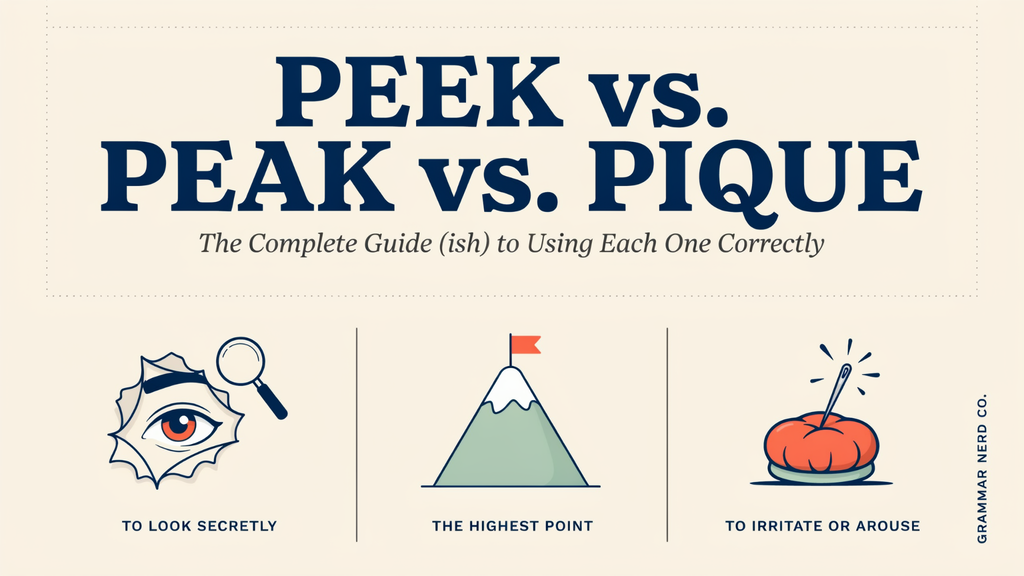
Peek is a quick look, often a bit sneaky or private. Peak is the highest point, the top end, the maximum level of something. Pique is to stir up interest, or to nudge someone into a reaction.
All three are pronounced the same, like /piːk/, it rhymes with “leak” or “seek” kinda clean and steady.
If you only remember one thing, keep this in your head: peek is about looking , peak is about the top , and pique is about triggering some feeling or response.
Peek: A Quick, Often Secret Look
“Peek” is used the most as a verb, but it can work as a noun too. At its core it basically describes a brief glance, usually one that feels furtive , kind of sneaky, or only partially showing the truth. You can picture it, like a kid trying to peep at wrapped presents, right before the holidays, or someone just casting a look around a corner before they step out. That quick, limited, a little secretive thing is what “peek” is going for.
As a Verb
“She peeked through the blinds to see who was at the door”
“He peeked around the corner before walking into the meeting.”
“The kitten peeked out from under the couch.”
As a Noun
“Can I get a peek at the new logo before it goes live?”
“The brand gave fans a sneak peek of the fall collection.”
A quick memory trick: imagine the two letter e’s in “peek” like a pair of eyes. Eyes are for looking, and looking is, honestly, most of what “peek” means.
Peek into What It Actually Means
“Peek into” pops up all the time in both straightforward and more figurative writing. In a literal sense, it means to look briefly inside something: “she peeked into the box before wrapping it.” In a more figurative sense, it means getting a small amount of insight into a topic, just a taste: “this report offers a peek into consumer spending habits.” Either way, the idea of partial access, kind of short-lived viewing, stays consistent.
A Little Peek: Why “Little” Changes the Tone
Throwing “a little” right in front of “peek” kinda softens the whole task, like it’s not a big deal, just a quick look. So “Just take a little peek and tell me what you think.” sounds more casual, more everyday too, even a bit friendlier than what you’d find in a formal memo, and honestly it also gives the sense that the timing is short, low stakes, you know?
Peek Out vs. Peak Out
This is where people trip up. What you want is “peek out” like the sun peeks out from behind the clouds, or her cat peeking out from the closet. “Peak out” gets used a lot but it’s the wrong one, and it doesn’t really match grammatically, because there’s no peak or summit happening. It’s more about visibility just briefly showing up, kind of like a quick glance through a gap.
Peak: The Highest Point
Now “peak” means the top, the highest tip, or the maximum level of something. That can be literal, like a mountain, or more of a figurative thing, like the highest point in performance demand or timing.
As a Noun
They finally reached the peak of the trail after a six-hour climb.
Traffic peaks around 5 p.m. on weekdays.
Her career peak came in her mid-thirties.
As a Verb
Sales tend to peak during the holiday season.
His popularity peaked shortly after the show’s finale.
As an Adjective
We’re heading into peak tourist season.
The athlete was in peak physical condition.
If “peek” is about eyes looking then “peak” is easiest to remember by imagining the letter A in the middle like a tiny mountain, which is basically the whole visual idea behind what it means.
Off-Peak Not “Off-Peek”
Ok so this one messes with people, mainly because “off- peek” feels like it should be a word, like it totally could exist. But no, it doesn’t. “Off-peak” is the one you want, it basically means a time with lower demand or activity , sort of the direct opposite of “peak” (that is highest demand). And yeah it’s spelled with an A every time, no debate. You’ll spot it nonstop in scheduling and pricing stuff, like “Off-peak train tickets are significantly cheaper because fewer people are traveling then,” or “call your provider during off-peak hours for shorter wait times.”
Peak vs. Peak Pro A Different Kind of Question
Also, some folks type things like “peak vs. peak” or “difference between peak and peak pro” and they’re not even thinking about grammar. They’re comparing two versions of a particular branded thing, like a tool or equipment piece, where “Peak” and “Peak Pro” are model names. That happens a lot with outdoor gear, software subscription levels, and consumer electronics.
If that’s what you meant, then the spelling part stays pretty much the same: “Peak” is correct as the base name, and “Pro” usually means an upgraded version. But if you’re actually trying to figure out what features differ between a specific company’s Peak and Peak Pro tiers, you’ll have to look at that manufacturer’s own comparison page. The specs change from brand to brand, and they don’t really have anything to do with English usage.
Pique: To Stir Up Interest or Irritation
“Pique” is the word people mix up way more than they admit, mostly because it’s kinda the least common one in normal day to day talk. A lot of folks just haven’t seen it on paper as much as “peek” or “peak.” so yeah, it slips.
As a verb, “pique” means to stimulate, arouse, or provoke, usually tied to “interest” or “curiosity.” It can also mean to irritate, nudge at someone’s pride, or basically put a little thorn where they don’t want it. As a noun, it points to a feeling of resentment or wounded pride, most often in the phrase “a fit of pique.”
Where it comes from: the trail goes back to French piquer, meaning “to prick” , which honestly fits if you imagine curiosity like it’s pricking at your attention, not letting you ignore it.
Stirring Interest or Curiosity
“The trailer piqued my curiosity about the sequel.”
“Her oddball answer piqued the interviewer’s interest.”
“A strong headline is built to pique the reader’s curiosity within seconds.”
Irritation or Provocation
“He was piqued by her dismissive tone.”
“She seemed piqued that nobody had asked for her opinion.”
As a Noun: Resentment
“In a fit of pique, he walked out of the meeting.”
Why “Piqued My Interest” Is the Only Correct Version
This is, like , the main searched confusion between the three words and it’s useful to spell it out without extra fluff:
“That article really piqued my interest.” Wrong. “Peek” is for glancing, and “interest” can’t really “glance” at all, not in a literal sense.
“That article really piqued my interest.” Wrong. This version kind of suggests your interest hit the top level, like it was already maxed out, then something happened. That’s not the idea.
“That article really piqued my interest.” Correct. The article stimulated or stirred up your interest , which is exactly what “pique” does.
Quick self-check: if you can swap “pique” with words like “stimulated” or “provoked,” and the sentence still sounds right, then “pique” is the word you want.
Quick Comparison Table
| Word | Part of Speech | Meaning | Example |
| Peek | Verb / Noun | A quick, often secret look | “She peeked through the door.” |
| Peak | Noun / Verb / Adjective | The highest point or maximum | “Demand peaked in December.” |
| Pique | Verb / Noun | To arouse interest, or a feeling of irritation | “The idea piqued his curiosity.” |
Pronunciation: Why the Confusion Keeps Happening in the First Place
All three words are pronounced basically the same: /piːk/ , like “leak” , “seek” , or “week”. That one little fact explains almost all of the mix-ups in this list, when you’re writing quickly, or you’re transcribing speech , or you’re depending on voice-to-text. Your ear really gives you no hints at all about which spelling you should use. It’s only the meaning of the sentence that helps, and nothing else.
| Word | Pronunciation | Rhymes With |
| Peek | /piːk/ | leak, seek, week |
| Peak | /piːk/ | leak, seek, week |
| Pique | /piːk/ | leak, seek, week |
If you’re asking a voice assistant how to spell one of these words, expect it to ask for more context. Audio alone genuinely can’t distinguish them.
A Fast Decision-ish Framework
When you’re mid sentence and you kinda aren’t sure, just run it real quick… like
Are you talking about a quick, or kind of tucked away look? then it’s “peek”
Are you talking about a top, a summit, or the very maximum? then you want “peak”
Are you talking about something that lit up interest, curiosity, or even irritation? use “pique”
Also, Try a Fast Swap Test
If “glance” seems to work, yeah ok , go with peek
If “summit” or “maximum” seems to fit, that points to peak
If “provoke” or “stimulate” fits better, that’s pique
Common Things to Watch For
“Peeked my interest” or “peeked/piqued my interest” instead of “piqued my interest.” This is, like, by far the most frequent oops, mostly because “peek” and “peak” feel more familiar, so your brain just grabs them, without asking permission. Keeping in mind that “pique” is about stirring up a feeling, not about looking, or reaching a maximum, usually fixes it for good
“Peak Out” Instead of “Peek Out”
If something (the sun, a cat, whatever ) is briefly coming into view, then it’s “peek out.” “Peak out” isn’t how people normally say it here
“Off-Peek” Instead of “Off-Peak.”
This one always means demand, timing, or scheduling. so it’s spelled with an A, every single time
Thinking spellcheck will catch it. it usually won’t. All three are legitimate, correctly spelled English words; the problem is the context, not the spelling. So only a grammar-aware check, or a careful re-read tends to catch it, before you send it out.
Frequently Asked Questions
1. What Is the Difference Between Peak and Peak?
“Peek” means a quick little look, sort of secretive or sneaky, while “peak” means the highest point , or the maximum level of something. They sound the same, but yeah, they get spelled and used differently.
2. Is It “Piqued My Interest” or “Piqued My Interest”?
It piqued my interest.” “Pique” means to stimulate or arouse interest, “peak” (a maximum) doesn’t really fit that meaning at all.
3. Is the Correct Phrase “Peek Out” or “Peak Out”?
“Peek out” is correct , it means something briefly becomes visible. Like, “the moon peeked out from behind the clouds.”
4. What Does “Peek Into” Mean?
It means to look briefly inside something , or in a figurative way, to get a small, limited glimpse of insight into a subject. Example: “this data offers a peek into user behavior.”
5. What Does “Off-Peak” Mean, and How Is It Spelled?
“Off-peak” refers to a period of lower demand or activity, like off-peak travel times or off-peak electricity rates. It’s always spelled with an A, never “off-peek” ok.
6. How Do You Pronounce Peek, Peak, and Pique?
All three are pronounced the same, /piːk/, which rhymes with “leak” and “seek.” The spelling changes, the sound does not.
7. What Does “In a Fit of Pique” Mean?
It describes a moment of irritation , or wounded pride, sometimes leading to an impulsive reaction. For example, “in a fit of pique, she quit the project.”
8. Where Does the Word “Pique” Come From?
It comes from the French word piquer , meaning “to prick.” That matches the idea of something sharply catching your attention or bruising your pride.
9. What’s a “Sneak Peek”?
A sneak peek is an early, quick look at something before it’s officially released or revealed. Like a movie trailer, a product preview, or a first look at what’s coming next.
Conclusion
The cleanest way to keep these three straight is to tie each spelling to a tiny visual cue: the two E’s in “peek” like a pair of watching eyes, the A in “peak” as a small mountain, and “pique” as the odd one out reserved for interest getting pushed or pride getting nicked.
Once that mental shortcut lands, the substitution test finishes the job: glance equals peek, summit or maximum equals peak, and provoke or stimulate equals pique. Send your next draft through that quick check, especially around phrases like “sneak peek,” “off-peak,” and “piqued my interest,” and this mix-up won’t trip you up again.