
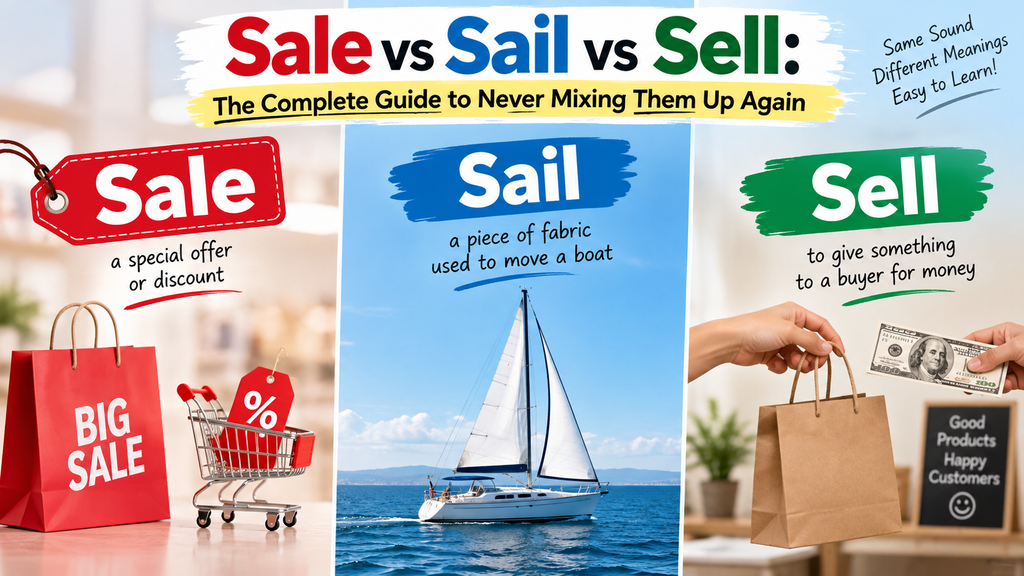
Sale vs sail is one of the most common homophone mix-ups in English. Both words are pronounced exactly the same way, /seɪl/, but they have completely different meanings and spellings. A sale is the exchange of goods or services for money, or a period of discounted prices. A sail is a sheet of fabric that catches the wind to move a boat, and, as a verb, it means to travel on water or glide smoothly.
If you have ever typed “the shop is having a sail” or “we set sale at dawn,” you are in good company. This guide covers the meaning, pronunciation, spelling and usage of both words. It also covers how they relate to sell, how to remember the difference, and the mistakes writers make most often.
Quick Answer: What Is the Difference Between Sail and Sale?
| Feature | Sale | Sail |
| Part of speech | Noun | Noun and verb |
| Core meaning | The act of selling; a discounted-price event | Fabric that catches wind; to travel by water |
| Pronunciation | /seɪl/ | /seɪl/ |
| Plural / forms | sales | sails, sailed, sailing |
| Typical context | Shopping, business, retail | Boats, sea travel, smooth progress |
| Example | “The sale ends tonight.” | “We will sail at sunrise.” |
The short rule: if money or shopping is involved, use sale. If water, wind or smooth movement is involved, use sail.
Why Are Sale and Sail Confused? Understanding Homophones
Sale and sail are homophones: words that sound identical but differ in spelling and meaning. English has hundreds of them, including there/their/they’re, fair/fare and tide/tied.
The confusion happens for three reasons:
- Identical sound. When you hear “seɪl,” your brain cannot tell which word is meant without context.
- Similar spelling. Both words are four letters and start with s and end with l. Only the middle vowels differ (a-l-e vs a-i-l).
- Autocorrect and speed. Spell checkers accept both words, so neither is flagged as a typo even when it is the wrong one.
Knowing the meaning behind each word is the only reliable fix.
Sale Meaning: Definition, Origin and Usage
What Does “Sale” Mean?
Sale is a noun with three main meanings:
- The exchange of a product or service for money. “The sale of the house was finalised on Friday.”
- A period when goods are offered at reduced prices. “The winter sale starts tomorrow.”
- The quantity or amount sold (usually plural). “Online sales doubled this quarter.”
The word comes from the Old English sala, related to Old Norse sala, and it shares a root with the verb sell.
Common Phrases With “Sale”
- For sale: available to buy (“The car is for sale.”)
- On sale: offered at a reduced price (“These shoes are on sale.”)
- Sale price: the discounted price
- Yard sale / garage sale: informal sale of household items
- Clearance sale: a sale to remove old stock
- Closing sale: a sale before a business shuts down
- Point of sale (POS): the place or system where a purchase is completed
- Sale of the century: an exaggerated phrase for a very big discount
Sale Examples in Sentences
- The sale of the old factory raised enough money to fund the new project.
- She bought three jackets during the sale.
- Is this laptop still for sale?
- Black Friday sales broke every record last year.
Sail Meaning: Definition, Origin and Usage
What Does “Sail” Mean?
Sail works as both a noun and a verb.
As a noun:
- A piece of strong fabric (canvas, nylon or polyester) attached to a mast that catches wind to propel a boat. “The captain raised the main sail.”
- A voyage or trip on water. “We went for a sail around the bay.”
As a verb:
- To travel on water, especially in a boat powered by wind. “They sailed across the Atlantic.”
- To move smoothly and effortlessly. “She sailed through the exam.”
- To start a journey by water. “The ship sails at noon.”
The word comes from the Old English segl, which has relatives in German (Segel) and Dutch (zeil).
Common Phrases With “Sail”
- Set sail: to begin a voyage (“They set sail at dawn.”)
- Smooth sailing / plain sailing: progress without difficulty
- Sail through: to succeed easily
- Take the wind out of someone’s sails: to deflate someone’s confidence or excitement
- Sail close to the wind: to take risks, or to behave almost illegally
- Under sail: moving by the power of sails
- Sailboat / sailing ship: a vessel powered by sails
- Sailor: a person who works on or navigates a boat
Sail Examples in Sentences
- The crew prepared to sail before the storm arrived.
- A torn sail slowed the yacht.
- After weeks of preparation, the project was smooth sailing.
- He sailed through his driving test.
Sale vs Sail Pronunciation: How Do You Say Them?
Both words are pronounced /seɪl/, and they rhyme with tale, pale, mail and whale.
| Word | IPA | Sounds like | Syllables |
| Sale | /seɪl/ | “sayl” | 1 |
| Sail | /seɪl/ | “sayl” | 1 |
| Sell | /sɛl/ | “sell” (short e) | 1 |
Pronunciation tip: the ai in sail and the a_e in sale both produce the long “ay” sound. The word sell is the odd one out, with a short e as in bed. Because the sound is the same for sale and sail, context is the only way a listener can tell them apart.
Sell vs Sale vs Sail: The Three-Way Confusion
Many learners also mix up sell with the other two. Here the problem is different: sell and sale are related in meaning, while sail is unrelated.
How Are Sell and Sale Related?
- Sell is a verb: the action of exchanging something for money.
- Sale is a noun: the result or event of that action.
So you sell a bike, and the bike’s sale is the transaction. Sell also has irregular forms: sell → sold → sold → selling.
Sell vs Sale vs Sail Comparison Table
| Word | Part of speech | Meaning | Pronunciation | Example |
| Sell | Verb | To exchange for money | /sɛl/ | “I want to sell my guitar.” |
| Sale | Noun | The act or event of selling; discount period | /seɪl/ | “The guitar sale ends Sunday.” |
| Sail | Noun / Verb | Wind-catching fabric; to travel on water | /seɪl/ | “We sail every summer.” |
Sale vs Sell Examples
| Correct | Incorrect | Why |
| “They will sell the house.” | “They will sale the house.” | A verb is needed |
| “The house is for sale.” | “The house is for sell.” | A noun is needed after for |
| “Her sale went through.” | “Her sell went through.” | A noun is needed |
| “He sold his car.” | “He saled his car.” | Sale is never a verb |
Rule of thumb: if you can put “to” in front of the word, you need sell, not sale. You can “sell” something. You cannot “to sale” something.
Sale Similar Words and Related Vocabulary
If you want to enrich your writing, here are words connected to sale by meaning, along with the homophone partners worth knowing.
Synonyms and Related Words for Sale
| Word | Meaning / how it relates |
| Transaction | A completed exchange of goods or money |
| Deal | An agreement or bargain |
| Bargain | An item sold at a low price |
| Discount | A reduction in price |
| Clearance | A sale to remove existing stock |
| Auction | A sale where buyers bid against one another |
| Vend / vending | To sell, often through a machine |
| Retail | Selling directly to consumers |
| Wholesale | Selling in bulk to businesses |
| Promotion | A marketing activity that may include a sale |
Words Related to Sail
Mast, hull, deck, anchor, voyage, vessel, crew, captain, navigate, harbour, voyage, sailor, sailing, sailboat, yacht, wind, canvas.
Homophones Similar to Sale and Sail
Sale/sail is one of many pairs that share the same sound. Others include:
| Pair | Meanings |
| Tale / tail | A story / the rear part of an animal |
| Male / mail | A man / letters and parcels |
| Pale / pail | Light in colour / a bucket |
| Whale / wail | A sea mammal / a loud cry |
| Bale / bail | A bundle / to remove water or release on bond |
Homophones of Tide: A Related Pair Worth Knowing
Many readers searching “sale vs sail” also look up homophones of tide, since both topics involve sea-related spellings. The word tide (the rise and fall of sea levels) has one common homophone: tied (the past tense of tie).
- The tide came in quickly.
- He tied the boat to the dock.
Both words are pronounced /taɪd/. Like sale and sail, they are easy to mix up in writing, so apply the same method: check the meaning first, then choose the spelling.
Sale and Sail Homophones in Sentences: Practice Examples
The best way to lock in the difference is to see both words working in the same sentence.
- The boat shop is having a sale on every sail in stock.
- We will sail to the island after the sale of the old yacht.
- Because of the sale, he could finally afford a new sail.
- She wanted to sail around the world, so she began a sale of her belongings.
- The yacht was for sale, and its torn sail lowered the price.
Fill in the blank:
- The store’s end-of-season ______ starts Monday. (sale)
- The captain ordered the crew to ______ at midnight. (sail)
- He tried to ______ his old phone online. (sell)
- The wind filled the ______ and the boat moved forward. (sail)
- Prices are lower during the ______ period. (sale)
How to Remember the Difference: Memory Tricks That Work
Mnemonic Devices
- Sail has “ai” like “air.” Air (wind) moves a sail.
- Sale ends in “e” like “earn.” A sale earns money.
- Sail has an “i” like “island,” a place you might sail to.
- Sales has “sell” in its sound. Both belong to the shopping world.
Strategy Comparison Table
| Method | How it works | Pros | Cons |
| Mnemonics | Link letters to meanings | Fast, memorable | Needs practice at first |
| Context check | Ask “Is this about money or water?” | Reliable in all cases | Slightly slower |
| Reading aloud | Hear the sentence logic | Catches sense errors | Doesn’t distinguish spellings |
| Spell checker | Automated scan | Instant | Misses correctly spelled wrong words |
| Proofreading backwards | Read the last sentence first | Spots isolated errors | Time-consuming |
The most effective combination is a mnemonic plus a context check.
Step-by-Step: How to Choose Between Sale and Sail
Use this simple process whenever you hesitate.
| Step | Action | Result |
| 1 | Look at the sentence topic | Is it about shopping, money or price? |
| 2 | If yes, check the word type | Is a noun needed? Use sale |
| 3 | If a verb is needed for selling | Use sell, not sale |
| 4 | If the topic is boats, water or smooth progress | Use sail |
| 5 | Re-read the full sentence | Does it make sense? |
Quick test: replace the word with “discount event.” If it fits, write sale. Replace it with “travel by boat.” If it fits, write sail.
Common Mistakes With Sale and Sail
| Incorrect | Correct | Explanation |
| “The shop has a big sail today.” | “The shop has a big sale today.” | The topic is discounts |
| “We set sale at dawn.” | “We set sail at dawn.” | Set sail is the fixed phrase |
| “Smooth sale ahead.” | “Smooth sailing ahead.” | The idiom uses sailing |
| “The yacht’s sale was torn.” | “The yacht’s sail was torn.” | A fabric part of a boat |
| “I will sale my bike.” | “I will sell my bike.” | A verb is needed |
| “It’s on sail now.” | “It’s on sale now.” | A price offer |
Practical Use Cases: Where Each Word Appears in Real Life
Where You Will See “Sale”
- E-commerce: “Flash sale,” “Summer sale,” “Clearance sale”
- Real estate: “Home for sale,” “Sale agreement”
- Business reports: “Quarterly sales figures”
- Legal documents: “Bill of sale,” “Sale deed”
Where You Will See “Sail”
- Sports and leisure: Sailing clubs, regattas, sailing lessons
- Travel: Cruises, ferry crossings
- Literature: Adventure novels and sea stories
- Everyday idioms: “Sail through the interview,” “Smooth sailing”
Why It Matters for Writers and Marketers
If you run an online store, a typo such as “Big Sail Today” can look unprofessional, confuse shoppers and weaken trust in your brand. For students and professionals, the error signals carelessness in formal writing. Getting these words right protects your credibility.
Pros and Cons of Relying on Context to Choose the Word
| Aspect | Pros | Cons |
| Using context | Works for every homophone pair | Needs full-sentence awareness |
| Memorising rules | Builds long-term accuracy | Takes time to internalise |
| Using grammar tools | Quick feedback | Not always accurate |
| Asking a peer to proofread | Fresh perspective | Not always available |
Best Practices for Using Homophones Correctly
- Learn pairs in groups. Study sale/sail, tale/tail and male/mail together.
- Write example sentences. Create your own for each word.
- Read widely. Exposure to correct usage builds instinct.
- Proofread twice. Once for grammar, once for homophones.
- Keep a personal list. Note the pairs you personally mix up.
- Use the context test. Ask “money or water?” before you finalise the word.
Frequently Asked Questions (FAQ)
1. What is the difference between sale and sail?
Sale is a noun meaning the exchange of goods for money or a period of reduced prices. Sail is a noun for wind-catching fabric on a boat, and a verb meaning to travel on water or to move smoothly. They sound identical (/seɪl/).
2. Are sale and sail homophones?
Yes. They are homophones: both are pronounced /seɪl/ but have different spellings and meanings.
3. What is the difference between sell and sale?
Sell is a verb (to exchange for money), and sale is the noun for the act or event of selling. You sell a car, and the car’s sale is the transaction.
4. How do you pronounce sale and sail?
Both are pronounced “sayl” and rhyme with tale and mail. The word sell has a different, short e sound (/sɛl/).
5. Is it “set sail” or “set sale”?
It is always set sail, meaning to begin a voyage. “Set sale” is incorrect.
6. What are the homophones of tide?
The homophone of tide is tied, the past tense of tie. Both are pronounced /taɪd/.
7. How can I remember which one to use?
Think of shopping and money for sale, and wind and water for sail. A quick trick: sail contains “ai” like “air,” which fills a sail.
Conclusion
The difference between sale vs sail comes down to meaning, not sound. Both are pronounced /seɪl/, so the only way to choose correctly is to check the context. Use sale for shopping, discounts and the act of selling. Use sail for boats, wind, voyages and smooth progress. Use sell whenever you need a verb for exchanging goods for money.
Remember the idioms (set sail, smooth sailing, for sale, on sale). Run the quick context test: money or water? Keep a short list of your personal homophone traps, and apply a mnemonic when you are unsure. With a few weeks of mindful practice, choosing between these words will become automatic.