
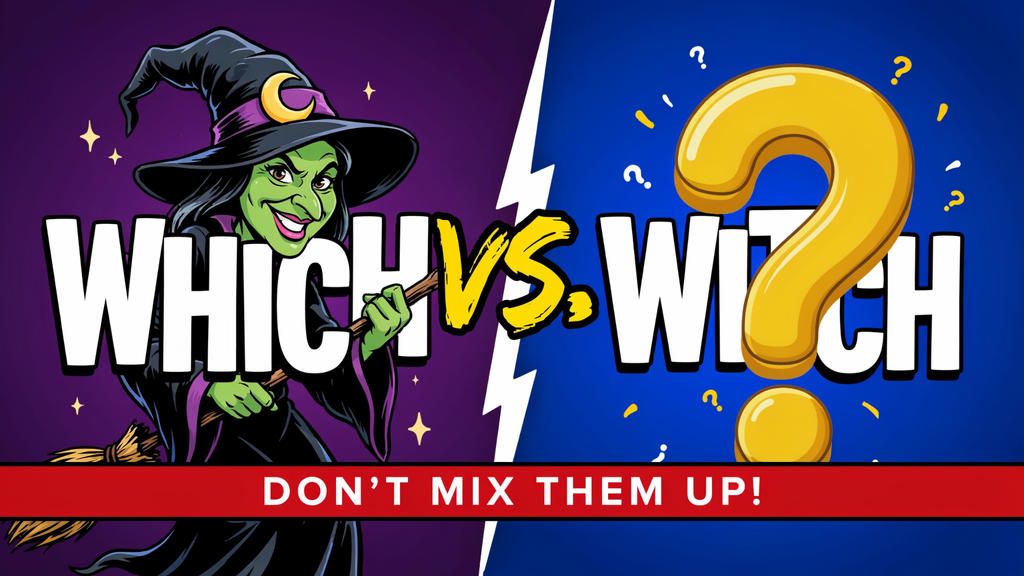
You’re writing out a sentence , you pause for a second and then suddenly you’re like wait, is it “which” or “witch” ? And no, you’re not just being dramatic, even pretty sure writers get tripped up. There’s a simple reason for it though. They sound the same, like 100% identical in most everyday speech, so your brain kinda slides them in without noticing.
But they don’t mean the same thing at all. Using the wrong one in an email , a school essay , or a social post can make your message feel a bit sloppy , in a way that spellcheck usually won’t flag.
The quick idea is this: “which” is the choosing word, the one you use to pick between options, while “witch” refers to someone linked with magic. Same sound, totally different meaning. Once you clock that contrast, it’s way easier to keep it straight.
This guide covers the whole thing you need, meanings and usage, grammar details, how they’re pronounced, the spelling logic that makes sense, plus a few memory tricks that actually stick around.
Which vs. Witch: The Core Difference
Let’s start with the plain definitions, side by side.
| Which | Witch | |
| Part of speech | Pronoun / determiner | Noun |
| Meaning | Used to ask about or point to a specific option among several | A person believed to practice magic, especially in folklore |
| Example | Which jacket is yours? | The witch stirred her cauldron. |
| Sounds like | rich, itch, stitch | rich, itch, stitch |
| Key spelling clue | Starts with “wh,” like what, when, where | Ends in “tch,” like catch, match, stitch |
They’re sort of textbook examples of a homophone pair, of two words that sound identical, but they differ in spelling, and also meaning. English has a lot of these (their/there/they’re, affect/effect), and which/which is one of the more common ones people look for, because the words are short, everyday, and easy to type on autopilot, like you don’t really think.
Why do people mix up which and which? It isn’t really a sign of poor grammar , it’s more like the two words got built in a way that makes confusion… kinda inevitable.
They’re pronounced the same in modern English: /wɪtʃ/. So you can say them both and it lands almost identical in your ear. They even share four or five letters, just swapped around a bit, like “wh-ich” versus “wi-tch.” And because both forms are spelled correctly, autocorrect won’t raise a little flag. A spellchecker basically looks at the spelling only, so if both are real English words then it has no clue which one you meant.
Fast typing and muscle memory do the rest, you know. One extra twitch of your fingers and suddenly you typed the wrong thing, especially if you’re thinking about the sound of the word first rather than the letters.
There’s also a small language detail behind why the sounds match for most people now. In some older, regional English dialects in parts of Scotland, Ireland, and the American South, “which” used to be pronounced with a breathy “hw” sound, like /hwɪtʃ/, which is slightly different from “witch” /wɪtʃ/.
Linguists describe the fading of that difference as the wine–whine merger, and yep, it also shows up in pairs like “wine” and “whine.” Most people today don’t keep that distinction, and that’s why which and which now sound completely alike to most ears.
Why do people mix up which and which? It isn’t really a sign of poor grammar , it’s more like the two words got built in a way that makes confusion… kinda inevitable.
They’re pronounced the same in modern English: /wɪtʃ/. So you can say them both and it lands almost identical in your ear. They even share four or five letters, just swapped around a bit, like “wh-ich” versus “wi-tch.” And because both forms are spelled correctly, autocorrect won’t raise a little flag. A spellchecker basically looks at the spelling only, so if both are real English words then it has no clue which one you meant.
Fast typing and muscle memory do the rest, you know. One extra twitch of your fingers and suddenly you typed the wrong thing, especially if you’re thinking about the sound of the word first rather than the letters.
There’s also a small language detail behind why the sounds match for most people now. In some older, regional English dialects in parts of Scotland, Ireland, and the American South, “which” used to be pronounced with a breathy “hw” sound, like /hwɪtʃ/, which is slightly different from “witch” /wɪtʃ/.
Linguists describe the fading of that difference as the winewhine merger, and yep, it also shows up in pairs like “wine” and “whine.” Most people today don’t keep that distinction, and that’s why which and which now sound completely alike to most ears.
“Witch”: Meaning, Origins, and Usage
“Witch” kind of refers to a person, traditionally shown as a woman who is believed to use magic, sorcery, or witchcraft stuff, you know, in folklore, fairy tales, or even historical accusations. In the story, the witch lived alone, in the forest. She wore a witch costume for Halloween . During the Salem witch trials , several people were wrongly accused of witchcraft , which is pretty tragic.
The word itself has deep roots . It comes from the Old English term wicce, meaning a female practitioner of magic, and it’s been hanging around in the language for well over a thousand years, long before it turned into some Halloween thing or a fantasy-fiction archetype.
Also , “witch” shows up in everyday expressions and compound words , worth knowing, just a little:
– Witchcraft : the practice tied to a witch
– Bewitch : to cast a spell on someone, or , figuratively, to charm or captivate them
– Witch hazel : a plant , and the astringent skincare extract made from it, often sitting in drugstores
– Witch hunt : historically a search for accused witches ; today used kind of metaphorically for an unfair campaign against someone based on shaky or unproven claims
That last one shows how far “witch” has traveled from its literal sense. Most people saying “witch hunt” nowadays aren’t thinking about magic at all, and that’s the point.
Witch vs. Wizard vs. Warlock: what’s the real difference?
Since “witch” , “wizard” and “warlock” get bundled together so often, it helps to untangle the differences I mean, but it’s mostly about meaning , not spelling , yeah.
| Term | Traditional association | How it’s used today |
| Witch | Historically linked to women; folk magic, herbal knowledge, witch trials | Now often used as a gender-neutral term for any magic practitioner |
| Wizard | A learned or wise magic-user, historically often male (“wizard” comes from “wise”) | Common in fantasy fiction for powerful or scholarly spellcasters |
| Warlock | Traditionally a male practitioner of dark magic, or literally an “oath-breaker” | Used in fantasy and games, often with a more sinister connotation than “wizard” |
In practice modern books, movies and games don’t always follow that old gendered split, ya know. “Witch” in particular has kinda become the default gender-neutral label across plenty of contemporary fiction, even if historically it leaned way more on the female side.
Is “Wich” a Word?
Short answer, no not really on its own. “Wich” usually only shows up inside other words and place names like sandwich, Norwich and Greenwich, kind of like a hidden piece. So if you type “wich” by itself, most of the time it’s just a shortened typo, like you meant “which” or “witch,” not some real standalone word.
And this is important because a lot of people look for this exact thing, they’re kinda unsure whether it should be “wich” , “which” or “witch” . The easiest way to steady yourself is this:
If you’re asking about an option, you want the wh spelling which, like what and when.
If you’re talking about magic, you want the ending witch, like catch and match.
Which vs. Witch: quick comparison in a sort of clear way that still feels natural
Sometimes the quickest method to remember something is to watch it happen, like, right there side by side, you know.
Using “which”:
Which movie should we watch tonight?
Tell me which shirt looks better.
The car, which was parked outside, wouldn’t start.
Using “witch”:
The witch in the fairy tale lived in a gingerbread house .
She’s dressing as a witch for the costume party.
Witch hazel is often used for soothing irritated skin.
If you read each pair out loud, you ’ll notice they sound identical , like really identical, and that’s the whole pointcontext, not sound, points you toward which word belongs where.
Common Mistakes ( and , how to Catch Them )
People sometimes write, which one do you want? when they mean which one do you want ? I mean , the “which” part matters because you’re really choosing between two or more options and yeah it’s always which?
Then there’s the classic mix-up where someone types which flew on a broomstick, but if you’re talking about the person tied to magic, it should be the witch flew on a broomstick. Which not which , that little switch is the whole point.
Another easy one is typing out of pure habit. Don’t trust muscle memory here, because which alone is not a real word in standard English.
Also, don’t just “assume” autocorrect will save you , it usually won’t. Since both options are spelled correctly, your spell-checker has basically no reason to complain. So the real fix is proofreading, ideally by reading your sentence out loud , because your ear will often catch what your eyes kinda skip over.
Easy Ways to Keep It Straight
If you keep second-guessing yourself, then one of these little tricks will probably stick , even if it sounds a bit silly at first
**Which** = **“wh”** like *what* , *when* , *where*. Yep, all those classic question words start the same way , so if you mean you’re picking between options, the spelling with **wh** is the one that belongs there too
**Witch** = **“tch”** like *itch* , *catch* , *match*. Just imagine a witch scratching an itch while, uh stirring her potion, and for some reason it looks a little dramatic and slightly goofy, but the reminder is solid
Try saying the whole sentence out loud and then ask yourself , “Am I choosing between things, or am I talking about magic?” That one tiny question, usually clears it up right away
Frequently Asked Questions
So what’s the actual difference between which and which?
“Which” is kinda like a pronoun-ish word, you use it to ask about, or point at, one specific option from a whole bunch. “Witch” is a noun, a person who’s connected to magic, sorcery, or spells. They sound nearly the same, yeah, but the meanings are totally disconnected, like they never really had a chat
Do which and which get pronounced the same?
Yeah, in standard modern English both usually come out as /wɪtʃ/. Some regional dialects used to add a little “hw” breathy sound with “which” but honestly that split has mostly faded, today
How do you spell witch for real?
W-I-T-C-H. It ends with “tch”, pretty much the same ending as you hear in catch and stitch
How do you spell which is right?
W-H-I-C-H, it starts with “wh”, like the vibe you get in what and when
Is “wich” a real word?
No, “which” isn’t really a stand alone word, by itself. It mostly shows up inside other words, like sandwich , Norwich, and Greenwich
What’s the difference between a witch and a wizard then?
“Witch” has often been linked traditionally with women plus folk-magic type stuff, while “wizard” was more often tied to learned, scholar-ish magic-users. These days “witch” can also work as a gender-neutral label for a magic practitioner, depending on the situation, and what the speaker is trying to say
Why doesn’t spellcheck catch this mix up?
Because both which and witch are totally legitimate words. Spellcheck usually only flags actual misspellings, not swaps in word choice, so you have to notice the mix-up yourself
Can “which” ever refer to a person?
Not directly, no. “Which” mainly fits things, choices, and options. When you mean people, English usually goes with “who”, like “the person who called”, rather than which, because it just feels off
Final Thoughts
So , which and which, kinda sound the same when you say them out loud, and that’s why the mix-up is so common. It’s not really about how careful you are as a writer, more like how our ears work. And the fix isn’t complicated at all. “Which” goes with your question words ( what, when, where ) and “witch” goes with words like catch and stitch.
Next time you pause mid-sentence, just ask yourself one small thing: am I choosing between options, or am I talking about magic? When you get that part right , the spelling usually follows on its own.